
What happens in a practice run
A presentation activity has three stages, shown at the top of the screen: Prepare, Present and Q&A. Feedback follows. One practice run can last up to 30 minutes.
- Prepare: read the task, who is listening and your learning goals. If you have slides, add them as a PDF. The audience reads them so they can ask better questions. Then check your microphone and start.
- Present: after a three-second count-in, you speak without interruption while a timer shows how long you've been speaking and when you reach your minimum length. The audience stays quiet, and pauses are fine. A side panel shows your brief, your slides and a transcript of what you've said so far.
- If your talk has a maximum length, you get a warning about 30 seconds before it. When time is up, the questions start as soon as you pause, or after 15 seconds.
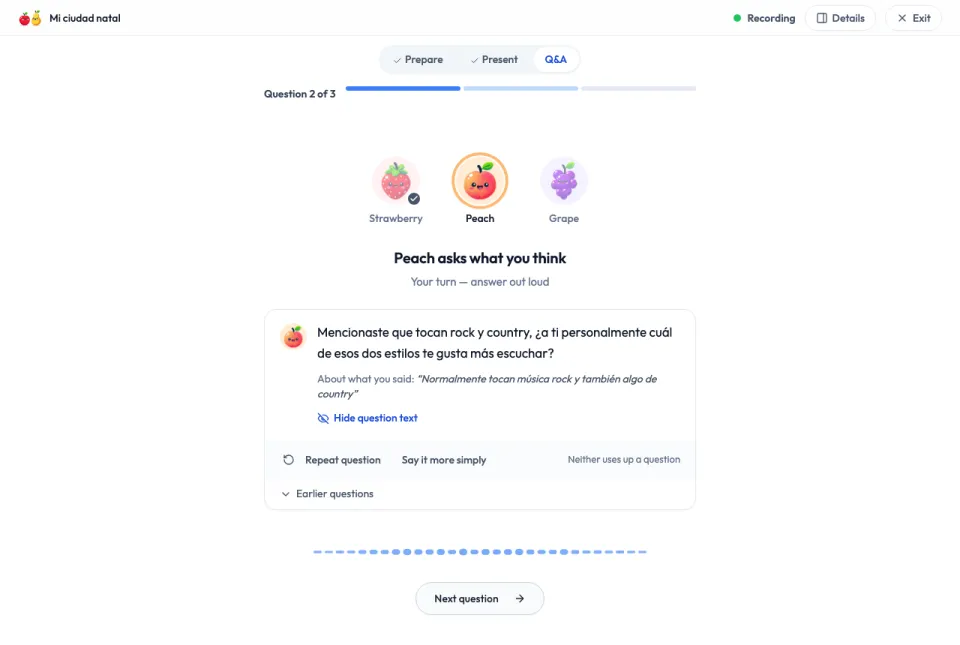
- Q&A: between one and five audience members, each with their own voice, ask one question each, in the language you're presenting in and at your level. Each question shows the words you said that it's about. You can hear it again, ask for it to be said more simply, or show the words on screen, and none of that uses up a question.
- After each answer, the person who asked reacts briefly to something you said. If your answer missed the question, they may ask one easier follow-up question instead.
- Feedback: when the last question is done, your feedback looks at the talk and the answers separately.
The Q&A, one question at a time
Each audience member asks one question, out loud. The question card shows which part of your talk it's about and lets you hear it again before you answer.
Why rehearse the questions, not just the talk
You can practice a talk until it runs smoothly. The questions afterward are different: you have to understand them in your new language, think, and answer, all within a few seconds. In a practice run, every question comes from something you actually said, so there's no canned answer to memorize. There are six kinds of question, and each one has a simple way in.
- Explain: someone asks you to restate a point. Say it again in simpler words, rather than repeating the same sentence.
- Example: give one concrete example, such as a place, a person, a number or a moment.
- Why: start with your reason in one sentence, then add one detail that supports it.
- How would it work: describe the first step, or what happens next.
- What do you think: give your opinion plainly, then one reason or experience behind it.
- A polite doubt: someone isn't convinced. Agree with the part that's fair, then explain your view.
- The mix follows your level. Beginner levels get explain, example and opinion questions. Intermediate levels can add why and how-would-it-work questions. Polite doubts come only at advanced levels and above.
Who it's for
Anyone who has to speak to a group in a language they're still learning, at any level and in any of 32 languages, English included. A beginner talk might be a one-minute description of a favorite place with two simple questions. An advanced one might be a six-minute proposal, with questions that can include a polite challenge.
- Students with a class presentation, or an oral exam that starts with a prepared talk.
- Professionals giving a project update, a pitch or a report to colleagues who work in that language.
- Researchers and speakers preparing a conference talk, where the Q&A is often the part they worry about most.
- Job candidates whose interview includes a short presentation followed by questions from the panel.
Preparing a talk in a language you're still learning
Write points, not a script. A script tempts you to read, and the moment a question pulls you away from it, you lose your place. A few habits make the talk and the questions easier.
- Pick two to four points, and give each one a reason or an example. That's what gives the audience something to ask about.
- Memorize only your first two sentences, your transitions between points and your last line. Those are the moments when nerves hit hardest.
- Say the key words of your topic out loud several times before you start. A word you've only read is hard to say under pressure.
- Plan a simpler way to say each technical term, so you can explain it if someone asks what you meant.
- Slides help the audience ask better questions, but your feedback can only credit what you say. If a point matters, say it out loud instead of leaving it on the slide.
- Before each run, write down two questions you'd least like to hear. Afterward, compare them with what the audience actually asked.
Four Q&A lines in Spanish
In any language, four lines carry you through most Q&As: ask for a repeat, ask for other words, restate the question, and promise to follow up. These Spanish versions use the polite form, which fits most presentations. For a full set in English, see our guide to answering questions after a presentation in English.
¿Podría repetir la pregunta, por favor?
Meaning: Could you repeat the question, please?
Polite and safe with any audience. With classmates you talk to casually, ¿Puedes repetir la pregunta? works too.
¿Me lo podría decir de otra forma?
Meaning: Could you say that another way?
This asks for different words, not just the same words again. Use it when one word in the question is new to you.
Si entendí bien, me pregunta por el costo, ¿verdad?
Meaning: If I understood correctly, you're asking about the cost, right?
Swap in the topic of the question. Costo is the usual word in Latin America. In Spain you'll also hear coste.
No tengo ese dato ahora, pero se lo confirmo después.
Meaning: I don't have that information right now, but I'll confirm it for you afterward.
A natural, polite promise to follow up. Say it only if you will.
The same four lines in French
These use vous, which works both for one person you don't know well and for the whole room.
Pardon, vous pourriez répéter la question ?
Meaning: Sorry, could you repeat the question?
This is how people usually ask out loud. The textbook form, Pourriez-vous répéter la question ?, is more formal and also fine in a presentation.
Vous pourriez reformuler, s'il vous plaît ?
Meaning: Could you rephrase that, please?
A common, polite request in meetings and classes. It asks for different words, not a slower repeat.
Si j'ai bien compris, vous parlez du budget, c'est ça ?
Meaning: If I understood correctly, you mean the budget, right?
Ending with c'est ça ? turns it into a quick check. Swap in the topic, for example des délais (the deadlines).
Je n'ai pas le chiffre exact en tête, mais je vous l'envoie après la présentation.
Meaning: I don't have the exact figure in my head, but I'll send it to you after the presentation.
Using the present tense for a promise about the near future is normal in spoken French.
The same four lines in Japanese
These are polite forms, right for a class presentation or a meeting at work.
すみません、もう一度お願いできますか。
Reading: Sumimasen, mō ichido onegai dekimasu ka.
Meaning: Sorry, could you say that once more?
Safe in class or at work. People also say just もう一度お願いします (once more, please).
もう少し簡単に言っていただけますか。
Reading: Mō sukoshi kantan ni itte itadakemasu ka.
Meaning: Could you say it a little more simply?
A polite request that tells the person you want easier words, not just a repeat.
スケジュールについてのご質問ですね。
Reading: Sukejūru ni tsuite no goshitsumon desu ne.
Meaning: So your question is about the schedule.
Swap in the topic before について. Confirming the topic out loud also gives you a moment to think.
申し訳ありません。確認して、後ほどお答えします。
Reading: Mōshiwake arimasen. Kakunin shite, nochihodo okotae shimasu.
Meaning: I'm sorry. I'll check and get back to you with an answer later.
A formal, workplace-safe way to say you don't know yet. 後ほど (later) sounds more polite in a presentation than the everyday あとで.
From a real practice session
Our team ran a short Spanish presentation about a hometown in ChitterChatter, using a synthetic voice to speak the learner's part. The audience's questions, their reactions and the feedback are what ChitterChatter produced. The talk is shortened to its opening and closing lines, plus the sentence the first question picks up on.
You
Hoy quiero hablar sobre mi ciudad natal.
Meaning: Today I want to talk about my hometown.
You
En el verano, hay un festival de música que es muy popular.
Meaning: In the summer, there's a music festival that's very popular.
You
¿Alguien tiene preguntas sobre mi ciudad natal?
Meaning: Does anyone have questions about my hometown?
Audience member
¿Qué tipos de música tocan normalmente en ese evento durante el verano?
Meaning: What kinds of music do they usually play at that event in the summer?
You
Normalmente tocan música rock y también algo de country porque a muchas personas en Millbrook le gusta ese estilo. A veces hay bandas locales que cantan sus propias canciones y es divertido verlos en el parque.
Meaning: They usually play rock and also some country, because a lot of people in Millbrook like that style. Sometimes there are local bands that sing their own songs, and it's fun to watch them in the park.
Audience member
¡Genial, me encanta el rock en vivo!
Meaning: Great, I love live rock!
Audience member
Mencionaste que tocan rock y country, ¿a ti personalmente cuál de esos dos estilos te gusta más escuchar?
Meaning: You mentioned they play rock and country. Which of those two styles do you personally like listening to more?
You
A mí me gusta más escuchar rock porque mis amigos y yo siempre escuchábamos rock juntos en el parque.
Meaning: I like listening to rock more, because my friends and I always used to listen to rock together in the park.
Audience member
¡Qué buen recuerdo con tus amigos!
Meaning: What a nice memory with your friends!
Audience member
Mencionaste que escuchaban rock juntos en el parque, ¿puedes darnos un ejemplo de alguna banda o canción favorita que solían escuchar?
Meaning: You mentioned you used to listen to rock together in the park. Can you give us an example of a favorite band or song you used to listen to?
You
Sí, claro. Nosotros escuchábamos mucho a una banda que se llama Imagine Dragons, especialmente la canción 'Radioactive'.
Meaning: Yes, of course. We listened a lot to a band called Imagine Dragons, especially the song "Radioactive."
Audience member
¡Esa canción tiene una energía increíble!
Meaning: That song has amazing energy!
What the feedback pointed out
What the learner said
A veces hay bandas locales que cantan sus propias canciones y es divertido verlos en el parque.
A clearer way to say it
es divertido verlas
The word for bands is feminine, so the pronoun that refers back to them needs the feminine form too.
What the learner said
También hay una biblioteca donde estudiantes estudian y leen libros.
A clearer way to say it
donde los estudiantes estudian
When Spanish talks about a general group of people, such as students, it usually puts a definite article (the word for "the") in front of the noun.
What your feedback shows
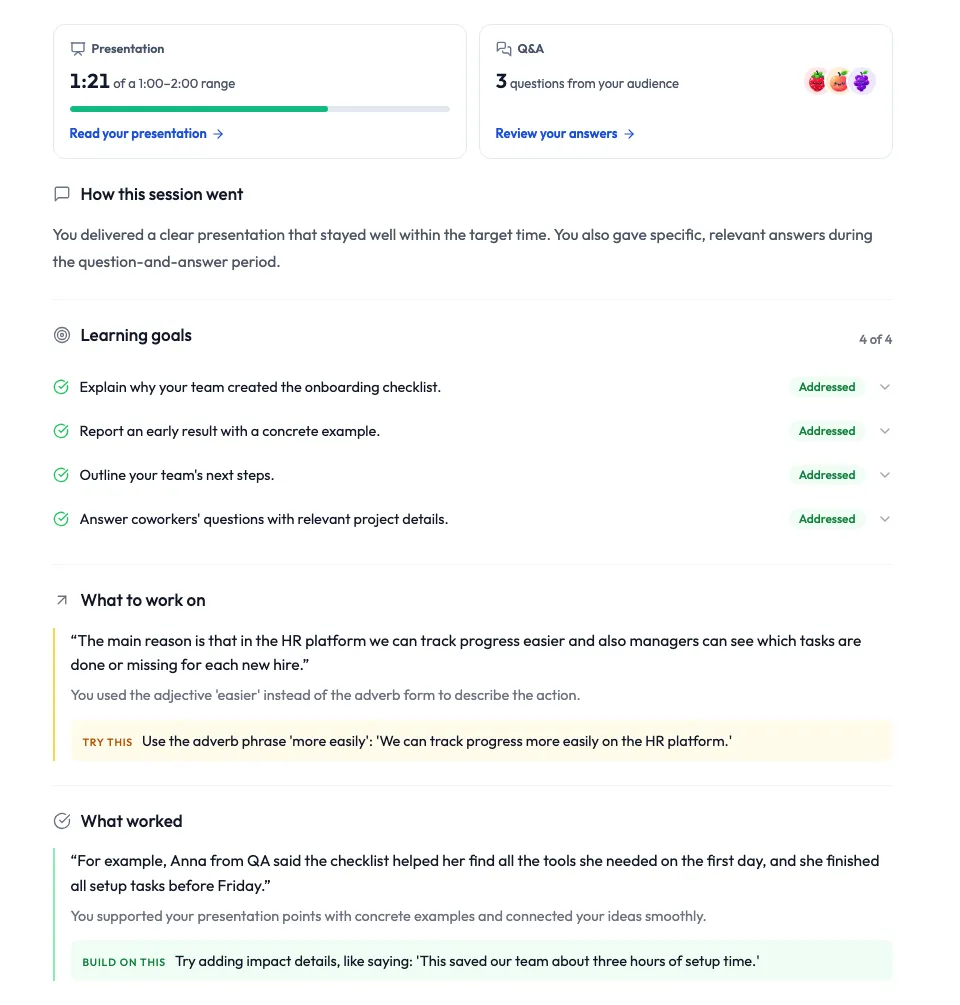
A talk and a Q&A are different kinds of speaking, so the feedback looks at them separately.
- Overview: how long you presented compared with your target, how many questions your audience asked, which learning goals came up, what to work on with a clearer way to say it, and what worked.
- Presentation: your talk as text, broken into paragraphs where you paused, with notes pinned to the sentences they're about. You can play back your recording.
- Q&A: each question, who asked it and what kind of question it was, your answer, and notes on that answer.
- AI Coach: ask questions about your feedback, for example how to make an answer shorter or why a suggested word fits better.
- The feedback is about what you said. For the talk, it looks at how well you covered the task, how you organized and supported your points, and the language you used. For the answers, it looks at how relevant they were, how clearly you explained, and the language you used.
The feedback screen
The Overview tab sums up both parts. The Presentation and Q&A tabs go through each one in detail.
Where to start
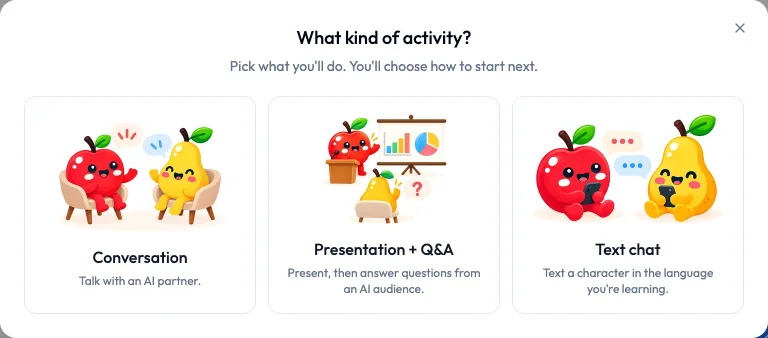
When you create an activity, ChitterChatter first asks what kind it is: a spoken conversation, a presentation with audience questions, or a text chat.
Set up practice for your own talk
Describe your real talk, and ChitterChatter builds the activity: the task, your learning goals, the length and the number of questions. Creating it uses one of your AI-built activities, and each practice run uses one conversation. It's free to start: 5 free conversations in your first week, then 3 a month. Pro is $18 a month or $120 a year.
- When you create an activity, choose Presentation + Q&A. Describe your talk: the language, who is listening, what you'll cover and your level. Or paste the example below and change the details.
- Say how long you want to speak and how many questions you want, from one to five. If you leave them out, both are set from your level.
- Read the task and goals, add your slides as a PDF if you have them, and present out loud. Then answer each question as it comes.
- Open your feedback. Check which goals came up, read the clearer way to say one of your lines, go through your answers on the Q&A tab, and ask the AI Coach about anything you want explained.
Describe it like this when you create the activity
A 3-minute presentation in Spanish for my coworkers at our team meeting in Mexico City. I'm presenting the results of our customer survey: the two biggest complaints, one change I recommend for each, and what happens next. Three coworkers ask me questions afterward. Intermediate High level.
Questions learners usually ask first
How do I practice a presentation in a foreign language?
Speak it out loud from short notes, not silently from a script, and time yourself. Practice the opening, the transitions and the closing until they come easily, then rehearse answering questions, because that's the part you can't plan word for word. Record a run and listen for the points that came out unclear.
Should I memorize my presentation in a second language?
Memorize the first two sentences, the transitions and the last line, but not the whole talk. A fully memorized script sounds stiff, and if you lose one sentence it's hard to find your way back. Speaking from a short list of points keeps you flexible when a question pulls you off track.
What should I do if I don't understand an audience question?
Ask once, calmly, for the person to repeat it or say it another way. Then restate the question in your own words to check that you got it before you answer. Audiences expect this from any speaker, and a correct answer to the right question matters far more than a fast one.
Can I practice a presentation in Spanish with AI?
Yes. In ChitterChatter you describe your talk, present it out loud in Spanish, and then answer spoken questions from an AI audience about what you said. It works the same way in any of the 32 languages, from French and Japanese to Arabic and Korean. Afterward, your feedback shows which goals came up and what to work on in the talk and in your answers.