
Restate, answer, check
Under pressure, many speakers either answer too fast or talk too long. This three-step pattern keeps your answer short and on target, and the first step gives you a few seconds to think.
- Restate: repeat the question in your own words. So the question is whether we can launch before March.
- Answer: give the short answer first, then one reason or example. Yes, if testing finishes on time. The main risk is the payment feature.
- Check: make sure you answered what they asked. Does that answer your question?
- In US workplaces especially, listeners expect the direct answer first and the background second. A long lead-in can make it sound like you're avoiding the question.
Buying a few seconds
A short pause is fine. These lines fill it naturally while you think. Use each one only once or twice in a Q&A, or it starts to sound scripted.
That's a good question. Let me think about that for a second.
Say it only when you mean it. If every question gets Great question!, people notice.
So if I understand correctly, you're asking about the timeline, not the budget.
This is the restate step. It also helps people at the back of the room, or on the call, who didn't hear the question.
When you didn't catch the question
Asking again is normal. Native speakers do it all the time, especially in big rooms and on video calls. Ask once, clearly, and apologize only once.
Sorry, could you repeat the question?
The standard version. In a relaxed team meeting, Sorry, say that again? is fine too.
Sorry, you cut out for a second. Could you say that again?
Say it right away. The longer you wait, the harder it is to ask.
Just to make sure I answer the right question: do you mean the cost to us, or to the customer?
Offering two options is easier for the other person than explaining the whole question again.
Difficult questions
Most hard questions fall into four types: one you can't answer, one that's really two questions, one that's off topic, and one that sounds like an attack. Each has a phrase that keeps you calm and in control.
I don't have that number in front of me, but I'll find out and follow up with you by Friday.
Naming a day makes this sound confident, so only promise one you can keep. In a casual setting, I'm not sure, but I'll get back to you. works.
That's really two questions. Let me start with the cost, and then I'll come back to the timeline.
Name both parts first so the person knows you heard both. The second part is the one speakers forget, so come back to it.
That's a bit outside what I covered today, but I'm happy to talk about it afterward.
In a meeting, Let's take that offline. means the same thing: talk about it later, not in front of everyone.
I understand the concern. Here's how we looked at it.
Stay calm and don't repeat their harsh words. If they keep pushing, I don't think we'll settle this today, but I'm happy to keep talking after the meeting. lets you move on.
Closing the Q&A
End on time and on your terms. Give a signal a few minutes early, then thank people and tell them how to reach you.
We have time for one more question.
Say it a few minutes before the end so you finish on time.
Thanks, everyone. If you think of anything later, just send me an email.
On a video call, add I'll drop my email in the chat. and then do it.
Q&A after a project update
You just presented a project update to about fifteen coworkers on a video call. Your manager opens the floor, and two people ask questions.
Manager
Thanks, that was really clear. Let's open it up for questions.
Marcus
Quick question. Are we still on track for March, and what happens if testing takes longer?
You
That's really two questions. First, yes, we're still on track for March. Second, if testing runs late, we'd push the launch back about two weeks, not more.
Marcus
Got it, thanks.
Elena
Do you know how many customers are still using the old version?
You
Just to make sure: do you mean all customers, or just the ones on the paid plan?
Elena
Just the paid ones.
You
I don't have that number in front of me, but I'll find out and send it to you by Friday. Does that work?
Elena
Perfect, thanks.
You
Great. If there's nothing else, thanks, everyone. Just message me if anything comes up.
The audio uses the AI voice you hear in ChitterChatter conversations.
What audiences expect in a US workplace Q&A
A direct question usually isn't an attack
In many US workplaces, people ask sharp questions about risks, numbers and deadlines because that's how they show they're paying attention. A blunt question often means the person is engaged, not angry. Answer the content calmly, and the tone usually relaxes.
Not knowing is fine. Guessing is risky.
Audiences tend to trust a speaker who admits a gap and promises an answer. A confident guess that turns out wrong is much harder to fix, because people repeat it after the meeting.
Questions in the chat
On video calls, questions often arrive in the chat. Read each one aloud with the person's name before you answer, for example Jordan is asking whether this affects the mobile app. That way everyone knows what you're answering.
Short answers leave room
If an answer goes past about a minute, stop and check whether it helped. Others may be waiting to ask, and the person can always ask a follow-up.
From a real practice session
Our team ran this situation in ChitterChatter using the description in the practice section below. A synthetic voice spoke the learner's lines; the AI character's replies and the feedback are what ChitterChatter produced. Here are the first lines of the conversation, lightly trimmed.
Coworker
Thanks for the update. How do you expect the new billing system to reduce support tickets?
You
The new system have a more clear payment process, so I think customers will not get confused so much. Also, we have more automatic emails if payment fail. That should help reduce the questions to support.
Coworker
Got it, that sounds helpful. What happens if testing falls behind, and how will support hear about any change to the March launch?
You
If testing is late, we maybe need to push the launch date back. We will tell support team with an email update, and maybe a short meeting if is big delay. Can you repeat the second part please?
Coworker
Sure, I was asking what percentage reduction in tickets finance used in its forecast.
You
Ah, sorry, I don't remember the exact percent that finance has for forecast. I think it was around fifteen percent, but I need to check the document for be sure. I can send you this number after the meeting, ok?
Coworker
That works, thanks. I'm curious how success will be measured after launch—do you have a plan for that yet?
You
Yes, we will track the number of support tickets about billing for some months after launch, and compare with before. If the number go down and customers pay faster, we say it is successful. Maybe we will also ask the support team for feedback.
Coworker
Makes sense, and it helps us know what to watch for. What kind of preparation do you think support should do before March?
You
I think support team should review the new billing steps and try the system if possible, maybe with some demo accounts. It's good to practice answer for new payment problems too. Do you think your team need special training for this?
Coworker
A short demo would help us a lot, and some sample questions to practice would be useful.
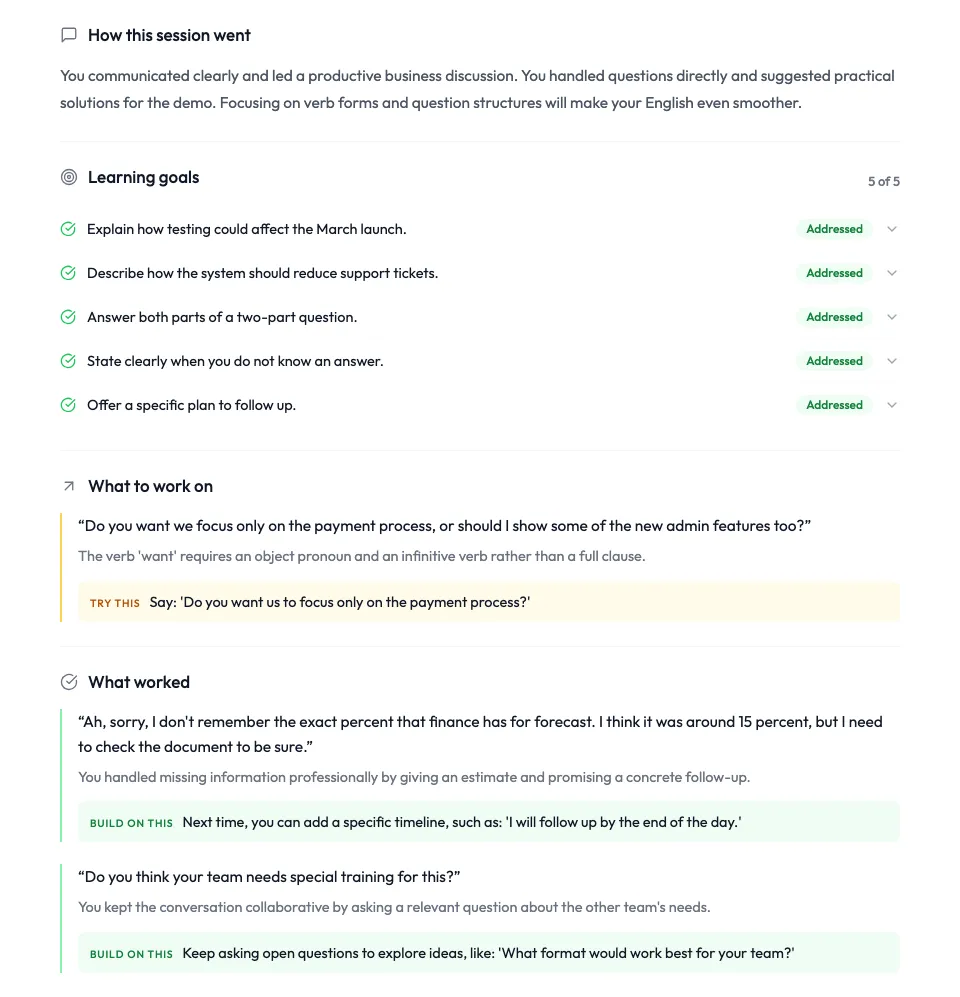
What the feedback pointed out
What the learner said
Do you want we focus only on the payment process, or should I show some of the new admin features too?
A clearer way to say it
Do you want us to focus only on the payment process?
After "want," English needs an object pronoun and an infinitive, not a full clause. The feedback listed this as the main thing to work on.
What the learner said
Also, we have more automatic emails if payment fail.
A clearer way to say it
if a payment fails
Payment here is a singular noun, so it needs an article and a verb form that matches it. Making it plural works too.
What the learner said
Can you repeat the second part please?
A clearer way to say it
Could you please clarify that last point?
This worked: you asked for clarification politely and kept the meeting moving. You can also ask the speaker to clarify their last point.
Rehearse the whole talk, too
If you want to give the talk itself before the questions, choose Presentation + Q&A when you create an activity. You present out loud, then an AI audience asks about what you actually said. Our guide to practicing a presentation in another language walks through it.
Rehearse the Q&A with an AI audience member
To drill just the questions, describe your talk in a few sentences, and the AI plays someone in the audience who asks you follow-up questions out loud. You answer by voice, just like in the real Q&A.
- Open Create with AI and describe your talk: the topic, your main points, and who will be listening. Or paste the example below and change the details.
- In your description, ask for at least one two-part question and one question you might not be able to answer, so you practice both.
- Answer out loud using restate, answer, check. A conversation can last up to 30 minutes, which is plenty for several rounds of questions.
- Review which learning goals you covered, the clearer version of one of your lines, and the transcript. Then ask the AI Coach how to make your longest answer shorter.
Describe it like this when you create the activity
English Q&A after my project update to about 15 coworkers at a US software company. My talk covered our new billing system: it launches in March, testing is the main risk, and it should reduce support tickets. The AI plays a coworker in the audience who asks me follow-up questions, including one two-part question and one I may not know the answer to. Upper-intermediate level.
Questions learners usually ask first
What do you say when you don't know the answer to a question in a presentation?
Admit it plainly, say how you'll find out, and give a time when you'll follow up. Then make sure you do. Audiences usually respect this more than a guess, and a wrong guess is much harder to correct later.
How do you handle a rude or hostile question after a presentation?
Stay calm, acknowledge the concern without repeating any harsh words, and explain your reasoning in one or two sentences. If the person keeps pushing, offer to continue after the session so the rest of the audience can move on.
How do you end a Q&A session politely?
A few minutes before the end, announce that there's time for one more question. After that answer, thank everyone and tell them how to reach you with more questions, such as by email or in the meeting chat.
How can I prepare for questions after my presentation?
Write down the five questions you'd least like to hear and say your answers out loud, not just in your head. Prepare one sentence for each that gives the direct answer first. Practicing with someone who asks unexpected follow-ups helps you get used to thinking on your feet.