
What Text chat is
Text chat is a practice activity where an AI character texts with you in the language you're learning. The character has a name, a relationship to you and a place, and the chat is built around something the two of you need to sort out.
- The character writes the way people really text: short messages, sometimes two or three in a row, in the casual or polite tone that fits who they are to you.
- Now and then, they react to one of your messages with an emoji, such as a heart or a thumbs-up, before replying, the way a friend would.
- You get a short list of goals, such as asking if they're free, suggesting a time and confirming where to meet. When the goals have to happen in order, they show as numbered steps.
- If your language needs a different keyboard, such as Japanese, Korean, Arabic or Thai, the brief reminds you to switch before you start. Spanish, French, German and other languages with accented letters get a row of buttons for those letters instead.
Texting or talking out loud: when to use each
Both practice the same thing, getting something done in another language, but they train different parts of it.
- Choose Text chat when you want time to think, to build a sentence you're unsure of, or to get used to writing in a new script or on a new keyboard.
- Choose a voice conversation when you need to answer in real time, understand what you hear, and keep going without looking anything up.
- Text chat is also the realistic choice when the situation really happens by message: making plans with a friend, writing to a host family, or replying to a colleague.
- A good routine: do a situation as a Text chat first, then practice the same situation as a voice conversation, using the lines you just wrote.
How a chat runs, start to finish
Here is what happens from the moment you open a Text chat.
- A short brief tells you who you're texting, what your goals are, how many replies you have and roughly how long it takes. Some chats open with the character's first message; in others, you text first.
- Several messages sent back to back count as one reply, just like real texting. Your goals tick off as you cover them, and you can see how many replies you have left.
- If you're stuck, ask for a hint. It tells you what to do next in your own language but never writes the reply for you. In beginner-level chats, Translate is on by default, so you can also see the character's messages in your language.
- The number of replies depends on your level. By default, ChitterChatter sets a range of 6 to 14 replies for Novice, 8 to 18 for Intermediate, and 10 to 24 for Advanced and above.
- The chat is complete once you've covered every goal and sent at least half the minimum number of replies, or once you reach the minimum. From there, you decide whether to end it or keep chatting. When you reach the maximum, the chat ends.
- If the character says goodbye before the chat is complete, the chat stays open so you can finish. You can end early, but a chat that ends before it's complete doesn't get feedback.
The chat screen
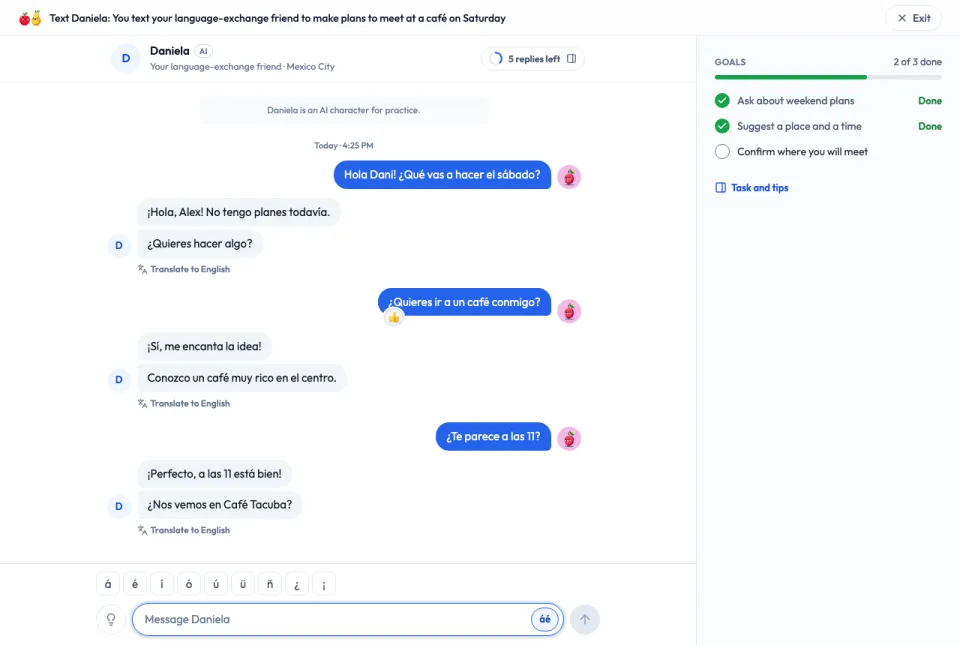
The thread looks like a messaging app, with your goals and the replies you have left kept in view.
Tagalog: weekend plans in Taglish
These three chats are real Text chat sessions our team ran with a test account. The learner's messages were typed by our test setup, and every reply from the character is exactly what ChitterChatter sent. Each excerpt leaves out the character's last two messages. Here, the learner texts Bea, a friend in Quezon City, to plan a snack after a long week. Both sides write Taglish, the mix of Tagalog and English that's everyday texting for many people in Metro Manila.
You
Hi Bea! Kumusta ka?
Meaning: Hi Bea! How are you?
Bea
Hi Alex! Mabuti naman ako.
Meaning: Hi Alex! I'm doing well.
Bea
Medyo pagod sa work. Ikaw, kumusta ang week mo?
Meaning: A bit tired from work. How about you, how was your week?
You
Free ka ba sa Sabado?
Meaning: Are you free on Saturday?
Bea
Oo naman, free ako sa Sabado!
Meaning: Of course, I'm free on Saturday!
Bea
Gusto ko nga lumabas para mag-meryenda.
Meaning: I actually want to go out for a snack.
You
Tara, kain tayo ng halo-halo!
Meaning: Let's go eat some halo-halo!
Bea
Yum! Gusto ko yan.
Meaning: Yum! I'd like that.
Bea
Anong oras tayo magkikita?
Meaning: What time will we meet?
You
Sige, kita tayo ng 3pm. Ingat!
Meaning: Okay, let's meet at 3pm. Take care!
Japanese: a casual café plan
The learner messages Yui, a language-exchange friend in Tokyo, to plan a Saturday café visit. It's casual Japanese of the kind friends send each other on apps like LINE: plain verb forms, no です or ます, and the odd emoji.
You
こんにちは!土曜日、ひま?
Reading: Konnichiwa! Doyōbi, hima?
Meaning: Hi! Are you free on Saturday?
Yui
ヤッホー!土曜日あいてるよ✨
Reading: Yahhō! Doyōbi aiteru yo
Meaning: Hey! I'm free on Saturday!
Yui
なにかある?
Reading: Nani ka aru?
Meaning: What's up?
You
いっしょにカフェに行かない?
Reading: Issho ni kafe ni ikanai?
Meaning: Want to go to a café together?
Yui
いいね!行きたい!
Reading: Ii ne! Ikitai!
Meaning: Sounds good! I'd love to go!
Yui
渋谷に新しいカフェができたよ☕️
Reading: Shibuya ni atarashii kafe ga dekita yo
Meaning: A new café opened in Shibuya.
You
2時はどう?
Reading: Ni-ji wa dō?
Meaning: How about 2 o'clock?
Yui
2時ね、ちょうどいいよ!
Reading: Ni-ji ne, chōdo ii yo!
Meaning: 2 o'clock, that works perfectly!
Yui
駅のハチ公前で会おうか?
Reading: Eki no Hachikō-mae de aō ka?
Meaning: Shall we meet in front of Hachiko at the station?
You
やった!楽しみ!
Reading: Yatta! Tanoshimi!
Meaning: Yay! I'm looking forward to it!
Spanish: meeting at a café in Mexico City
The learner texts Daniela, a language-exchange friend in Mexico City, to meet at a café on Saturday. Notice how relaxed it is: Daniela's Hola Alex! skips the opening exclamation mark, as many people do in quick texts.
You
Hola Dani! ¿Qué vas a hacer el sábado?
Meaning: Hi Dani! What are you doing on Saturday?
Daniela
Hola Alex! Nada especial todavía.
Meaning: Hi Alex! Nothing special yet.
Daniela
¿Tienes algún plan en mente?
Meaning: Do you have any plan in mind?
You
¿Quieres ir a un café conmigo?
Meaning: Do you want to go to a café with me?
Daniela
¡Sí, me encanta la idea!
Meaning: Yes, I love the idea!
Daniela
Conozco uno muy lindo en la Roma.
Meaning: I know a very nice one in Roma.
You
¿Te parece a las 11?
Meaning: Does 11 work for you?
Daniela
¡Perfecto! A las 11 está súper bien.
Meaning: Perfect! 11 is great.
Daniela
¿Nos vemos afuera del café o adentro?
Meaning: Shall we meet outside the café or inside?
You
Va, nos vemos ahí. Gracias!! jaja
Meaning: OK, see you there. Thanks!! haha
What to notice in these chats
Each chat shows habits a textbook usually skips.
- Bea's Medyo pagod sa work and the learner's Free ka ba sa Sabado? drop English words into Tagalog sentences. That isn't a mistake; it's how many people in Manila text their friends. Tara, come on or let's go, and Ingat!, take care, are everyday ways to suggest a plan and to sign off.
- The learner opened with こんにちは, which reads a little stiff between friends. Yui's ヤッホー is a playful hi, and many friends skip the greeting and get straight to the point.
- Asking 行かない?, literally won't you go?, is the natural casual way to invite someone. Endings like よ and ね in Yui's messages add warmth, and ハチ公前, in front of the Hachiko statue at Shibuya Station, is one of Tokyo's best-known meeting spots.
- jaja is laughter, and Va is a casual okay or deal, common in Mexico. Súper bien is a relaxed way to say really good, and la Roma is a popular Mexico City neighborhood.
The feedback screen
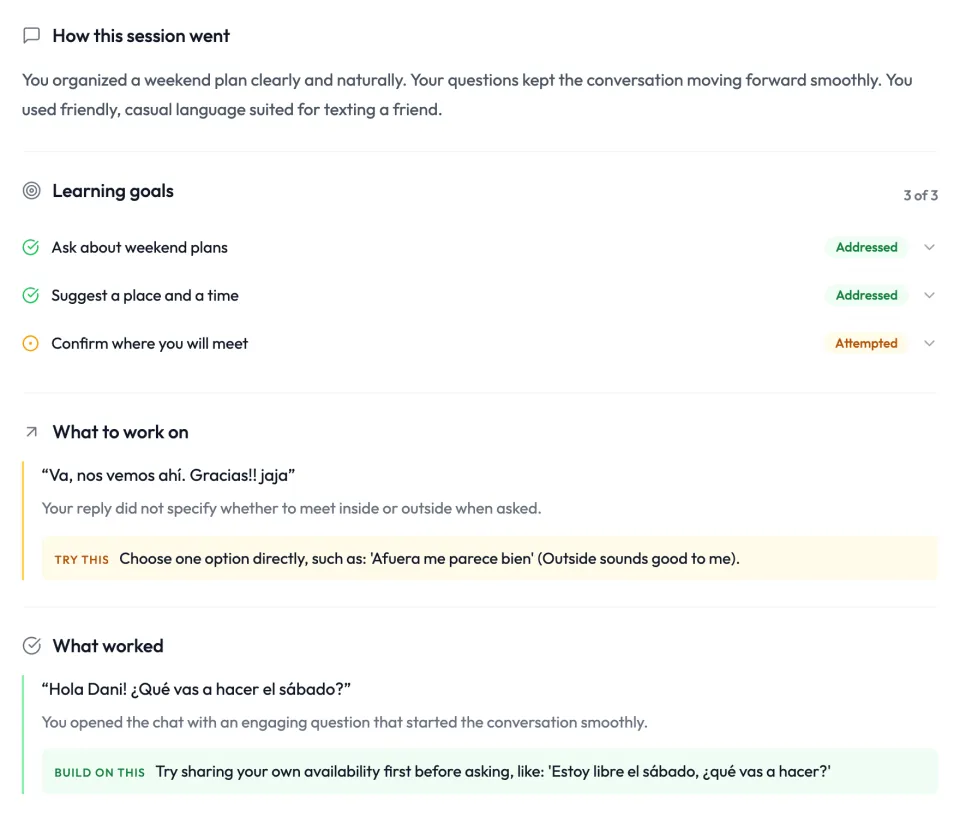
This is the real feedback from the Spanish chat above. Two goals show as addressed and the third, confirming where to meet, as attempted. The note under What to work on points out that Daniela asked whether to meet inside or outside, and the reply didn't say.
What the feedback looks at
Feedback reads exactly what you typed, so it can comment on your word choice, on how casual or polite you were for the person, and on whether you did what each goal asked.
- How this session went: a short summary of the chat.
- Learning goals: each goal with its status, such as addressed or attempted, which you can open for more detail.
- What to work on: a line you sent, what it missed, and a clearer way to say it.
- What worked: a line that worked well, with an idea for building on it next time.
- The full transcript, and an AI Coach you can ask about any suggestion.
- Spelling is judged by the style of the chat. In a casual texting chat, lowercase letters, missing accents and laughter like jaja aren't counted as mistakes, but a typo that changes the meaning is. When a chat calls for standard spelling, accents and punctuation count.
One habit the feedback caught in all three chats
All three chats were complete, and all three got a note on the same habit: moving on without answering the friend's question. Here is the line each learner sent and the clearer reply the feedback suggested.
- Tagalog: Bea asked how the week was, and the learner jumped to Free ka ba sa Sabado? The feedback suggested answering first with Mabuti naman ako!, I'm doing fine!
- Japanese: Yui suggested meeting at Hachiko, and the learner replied やった!楽しみ!, yay, can't wait!, without confirming the place. The feedback suggested うん、ハチ公前で会おう!, yeah, let's meet in front of Hachiko!
- Spanish: Daniela asked whether to meet inside or outside the café, and the learner replied Va, nos vemos ahí. Gracias!! jaja The feedback suggested picking one: Afuera me parece bien, outside sounds good to me.
- In a real thread, an unanswered question usually means another round of messages, or a friend waiting at the wrong door. Before you send, check that you've answered everything the other person asked.
Texting habits change from language to language
Laughter
Spanish speakers type jaja. Thai speakers type 555, because the number five is pronounced ha. Chinese speakers often write 哈哈, Korean speakers ㅋㅋ, and Japanese speakers 笑 or a string of w.
Mixing languages and scripts
Mixing in English is normal in many places, as in the Taglish chat above. Many Hindi and Urdu speakers text in Roman letters rather than Devanagari or Urdu script, and the characters in our Hindi and Urdu test chats wrote that way too, with lines like Saturday 6 baje perfect hai!, Saturday at 6 is perfect!
Politeness still shows
Short messages don't mean politeness disappears. Korean texts keep polite 요 endings with anyone you haven't agreed to speak casually with; our KakaoTalk guide, linked on this page, walks through a full thread. Japanese friends drop です and ます with each other, but you'd keep them when messaging a teacher or a manager.
Punctuation carries tone
In casual Spanish texts, the opening ¡ and ¿ are often skipped, though they're expected in careful writing. In Korean and Japanese, a tilde or an emoji softens a message, and to some people a plain period at the end can feel a little cold.
Where to start
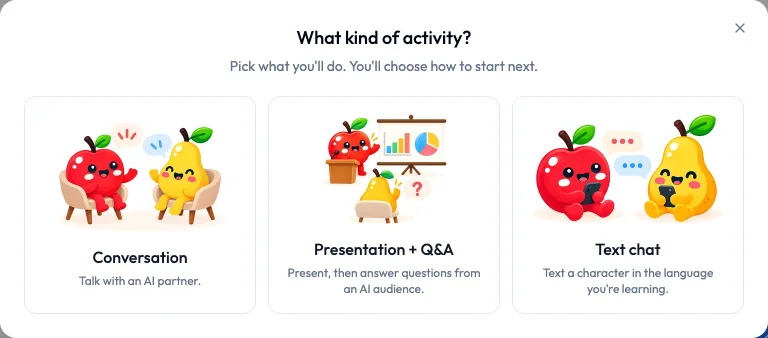
When you create an activity, ChitterChatter first asks what kind it is: a spoken conversation, a presentation with audience questions, or a text chat.
Set up your own Text chat
Pick a plan you'd really make by text in your target language. ChitterChatter is free to start: 5 free conversations in your first week, then 3 a month. Creating a Text chat uses one AI-built activity, and each time you practice it uses one conversation. Pro is $18 a month or $120 a year.
- When you create an activity, choose Text chat and describe the situation. You can paste the description below and change the language, city and plan.
- Read the brief: who you're texting, your goals and how many replies you have. If your language uses another script, switch your keyboard before you start.
- Text back and forth until your goals are covered. Ask for a hint if you get stuck, and answer every question the character asks.
- Open the feedback to see which goals you covered, a clearer way to say one of your lines, what worked and the full transcript. Ask the AI Coach about any suggestion, then try the same situation out loud as a voice conversation.
Describe it like this when you create the activity
Spanish, texting a language-exchange friend in Mexico City. The AI plays Daniela, a friend about my age who texts casually. I need to ask if she's free on Saturday, suggest a café and a time, and agree on where to meet. Beginner level.
Questions learners usually ask first
Does practicing texting help you speak a language?
Yes, in a specific way. Texting makes you recall words and build sentences yourself, with time to think, so phrases you use often get easier to say. It doesn't train listening at natural speed or answering in real time, so pair it with spoken practice of the same situation.
How do I type in Japanese, Korean or Arabic on my phone or computer?
Add the language's keyboard in your device's keyboard or language settings. For Japanese, most learners type in romaji and pick the right kana or kanji from the suggestions, or use the kana keyboard on a phone; Korean uses the standard Hangul keyboard; Arabic has its own keyboard and writes right to left. Switching between keyboards gets quick after a few days.
Should I text casually or politely in another language?
Match the relationship, the way you would in person. With friends your age, casual texting is normal; with someone older, a teacher, a landlord or a colleague you don't know well, stay polite until they relax the tone. In languages with distinct polite forms, like Korean and Japanese, the choice shows in every sentence ending, so decide before you send the first message.
Can I practice texting in another language with AI for free?
ChitterChatter is free to start: 5 free conversations in your first week, then 3 a month. A Text chat uses one AI-built activity when you create it and one conversation each time you practice it. Pro is $18 a month or $120 a year.