
Clear beats native-sounding
Accents are normal in US, UK and Australian workplaces, and many interviewers have worked with plenty of non-native speakers. What hurts an answer is losing the listener: no clear start, very long sentences, or a story that jumps around. These habits help more than advanced vocabulary.
- Say the point first, then the details. Your first sentence should answer the question.
- Keep sentences short. Two short sentences are easier to follow than one long one.
- Slow down a little and pause between the parts of your answer. A one-second pause sounds confident, not lost.
- Use signposts so the interviewer knows where you are: First, The result was and So in short.
Your self-introduction in three parts
When they say Tell me about yourself or Walk me through your background, go present, past, then future. With two or three sentences per part, your answer takes about 60 to 90 seconds at a calm pace.
Right now, I'm a data analyst at a logistics company, where I build reports for the operations team.
Start with now, not with your childhood or your degree. If you're between jobs or studying, begin with Most recently, I
Before that, I spent three years in customer support, which is where I got interested in data.
Watch the small word after a length of time: three years in customer support, three years of experience. It's easy to drop when you're nervous.
Now I'm looking for a role where I can work more closely with product teams, and that's why this position caught my eye.
End by connecting to their job. The phrase caught my eye sounds friendly; is a strong fit for me is a little more formal.
STAR answers: the transitions to memorize
For questions that begin with Tell me about a time, use Situation, Task, Action, Result. Many speakers freeze in the move from one part to the next, so memorize these bridges and fill in your own story.
At my last job, we had a problem with late deliveries.
Keep this part short. Many people spend half the answer here.
My job was to find out why and fix it before the holiday season.
Also common: I was responsible for and I was asked to.
So what I did was look at three months of data, and then I set up a weekly call with our two biggest carriers.
Use I here, not we. Link the steps with First, Then and After that.
As a result, late deliveries dropped by 30 percent in two months.
You can finish with what you learned: What I took away from that was.
Past tense and numbers: where answers go wrong
When people get nervous, they often slide between tenses or rush through numbers. Both make a story harder to follow. Check these before the interview.
- Tell a finished story in the simple past from start to finish: I called the client, I explained the delay, and she agreed. Switching to the present halfway through, as in so I call the client, is common in casual storytelling, but in an interview it can blur the timeline.
- Use the present perfect only for something still true now: I've worked in logistics for five years. For a job you left: I worked there for five years.
- Say numbers slowly and in full, and round them when the exact figure doesn't matter: thirty percent, one point two million dollars, about two thousand users.
- Stress the ending to separate fifteen from fifty: fif-TEEN versus FIF-ty. If a number really matters, add context, as in fifteen people, so about half the team.
Asking them to repeat or rephrase
Interviewers expect clarification questions. Asking is far better than giving a great answer to a question they didn't ask.
Sorry, could you say that one more time?
Once per question is fine. You don't need to explain why.
Just to make sure I understand, are you asking about a time I led a project, or a time I worked on one?
Repeating the question in your own words also gives you a few seconds to think.
That's a good question. Do you mind if I take a moment to think about it?
A five-second pause feels much longer to you than it does to the interviewer.
A behavioral question on a video interview
A video interview for a project coordinator role at a US company. The hiring manager asks a STAR-style question, and the audio breaks up for a moment.
Interviewer
Can you tell me about a time you had to manage a tight deadline?
You
Sorry, you broke up for a second. Could you repeat the last part?
Interviewer
Sure. A time you had to manage a tight deadline.
You
Okay. At my last job, our biggest client moved their launch up by two weeks, and my job was to get all the training materials ready in time.
Interviewer
Mm-hm.
You
So what I did was split the work into daily goals, and I asked two people from another team to help with the videos.
Interviewer
And how did it turn out?
You
We finished a day early, and the client renewed their contract for two more years.
Interviewer
That's great. What did you learn from that?
You
What I took away from it was to ask for help early, not at the last minute.
The audio uses the AI voice you hear in ChitterChatter conversations.
How much to promote yourself
Say what you did, out loud
US interviewers usually expect you to describe your own contribution plainly, with numbers if you have them. If you learned to work somewhere where talking about your own success sounds like bragging, this can feel uncomfortable. In an interview it's information they need, not bragging. A useful middle path is to credit the team and then name your part: The team launched it, and my part was the testing plan.
UK and Australian interviews
UK and Australian interviewers also ask for specific examples and results, often with the same behavioral questions. Many respond better to a calm, factual tone than to big words like amazing or incredible, so let the numbers do the work. Expectations vary by company and industry in every country.
Confident, not perfect
Don't apologize for your English before you answer. A line like Sorry, my English isn't very good can make the interviewer listen for mistakes. If you need a repeat or a moment, ask for it simply and keep going.
Video interview audio
Use earbuds or a headset with a microphone, and close the door. Join a few minutes early to test sound in the same app they're using. If the line has a delay, wait a beat after they finish before you start, so you don't talk over each other. If the audio drops, say Sorry, you broke up for a second. and ask them to repeat.
From a real practice session
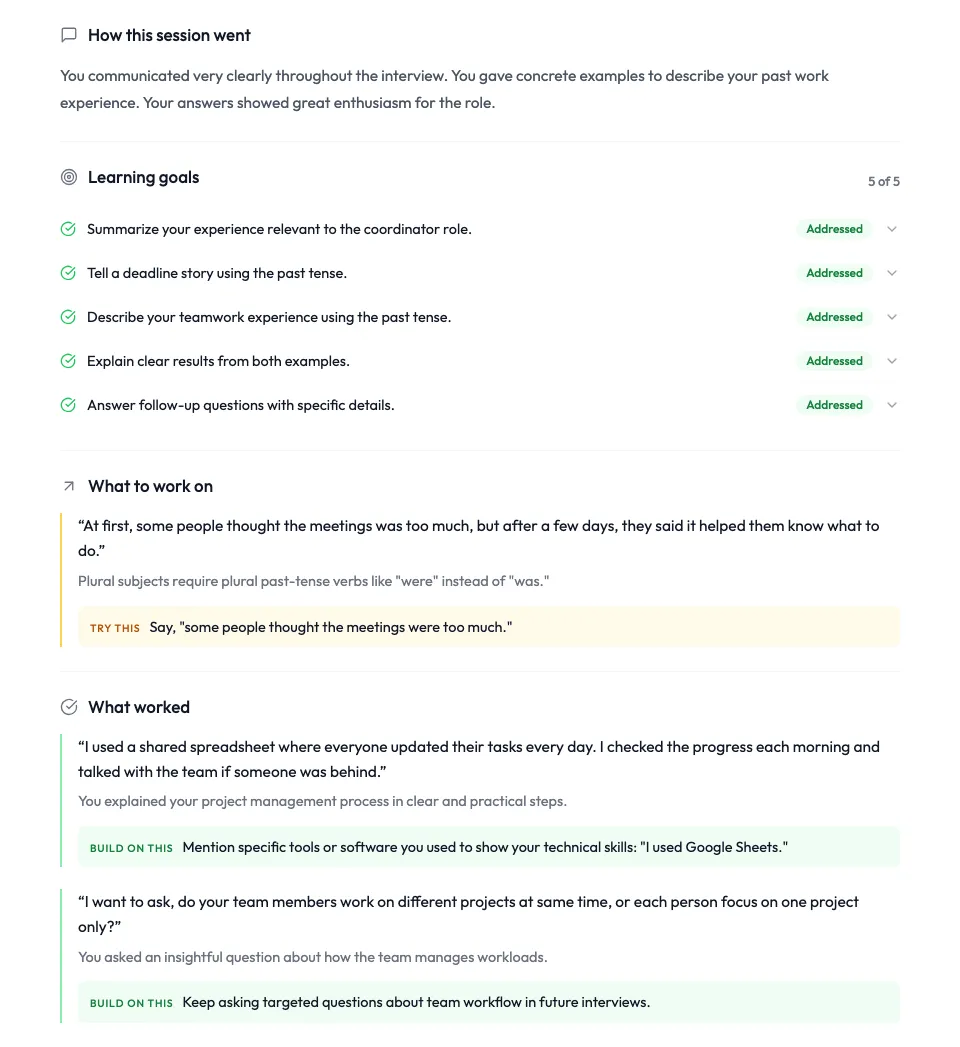
Our team ran this situation in ChitterChatter using the description in the practice section below. A synthetic voice spoke the learner's lines; the AI character's replies and the feedback are what ChitterChatter produced. Here are the first lines of the conversation, lightly trimmed.
Interviewer
Hi, thanks for joining the call. To start, could you tell me about yourself and your experience?
You
Hello, thank you for giving me this chance. My name is Rohan and I have three years of experience as a project assistant in an event management company. In my last job, I helped organize big conferences and managed schedules for several teams. I am good at planning tasks and making sure projects finish on time. I want to work with your company because I like museums and I am interested to learn more about exhibit production.
Interviewer
That’s a great start, thanks. I’d love to hear more about your experience, so let’s dive into the first example. Can you tell me about a time you had to meet a difficult deadline?
You
Yes, sure. Last year, we got a new client who wanted a conference set up in just two weeks. Usually, we take one month for this. I made a detailed schedule and split the work for the team. We finished everything two days early, and the client was very happy. Can you please rephrase if I miss something?
Interviewer
Of course. You said there was a conference that usually took a month to plan, but you only had two weeks, and you made a detailed schedule and split the work so the team finished two days early. Could you tell me more about how you tracked progress during those two weeks?
You
Yes, I used a shared spreadsheet where everyone updated their tasks every day. I checked the progress each morning and talked with team if someone was behind. This way, we could fix problems fast and stay on track. Is this answer okay, or you want more details?
Interviewer
That’s clear, and I like how you used the daily updates—what was your own role each day to keep things moving?
You
Each day, I checked everyone’s update and made a short meeting in morning to talk about any issues. I also helped team members if they needed document or contact details. One day, the vendor was late to reply, so I called them directly to solve the problem. Because of this, we did not lose any time.
Interviewer
That sounds very hands-on. How did the team respond to those daily check-ins?
You
At first, some people thought the meetings was too much, but after few days, they said it helped them know what to do. The updates made it easier to ask for help when someone stuck. I think our team felt more connected and finished work more smooth. Did you use daily check-ins in your company also?
Interviewer
We do, but in a lighter way—we have a weekly planning meeting and quick check-ins as needed. Could we shift to the second example now—when you worked with others to complete a project?
What the feedback pointed out
What the learner said
At first, some people thought the meetings was too much
A clearer way to say it
Some people thought the meetings were too much.
The subject "meetings" is plural, so the past-tense verb needs to be plural too: "were," not "was."
What the learner said
Is this answer okay, or you want more details?
A clearer way to say it
Does that answer your question, or would you like more details?
The question sounds slightly informal for a professional interview.
What the learner said
I think our team felt more connected and finished work more smooth.
A clearer way to say it
Our team felt more connected and finished work more smoothly.
To describe how an action was done, use the adverb form "smoothly" instead of "smooth."
Run a mock interview out loud
Reading your answers is not the same as saying them while someone waits. A voice mock interview helps the transitions and the past tense become automatic.
- Open Create with AI and paste the description below, changing the job title and company to match the role you're applying for.
- Answer the self-introduction and at least two STAR questions out loud. Ask the AI interviewer to repeat or rephrase at least once.
- In the feedback, check which learning goals you covered and the clearer version of one line you said. Read the transcript for tense switches.
- Ask the AI Coach how to shorten your longest answer, then do the interview again.
Describe it like this when you create the activity
English job interview on a video call for a project coordinator role at a US company. The AI plays the hiring manager, who asks me to tell them about myself and then two behavioral questions about deadlines and teamwork, with follow-up questions on my answers. I want to practice 60 to 90 second answers in the past tense with clear results. Intermediate to upper-intermediate level.
Questions learners usually ask first
How long should my answer to Tell me about yourself be?
About 60 to 90 seconds is a good target. That's enough for your current role, one or two earlier steps, and why you want this job. If the interviewer wants more detail, they'll ask a follow-up.
Can I practice English interview questions with AI?
Yes, and it helps most when you answer out loud and get follow-up questions, not just read model answers. In ChitterChatter, you describe the job and the AI plays the interviewer, asking questions by voice and following up on what you say. Afterward you see a clearer way to say one of your lines and the full transcript, so you can spot tense switches and try again.
Should I memorize my interview answers?
Memorize the structure, your first sentence and the transitions between parts, but not every word. Fully memorized answers often sound recited, and they're hard to adapt when the question is slightly different. Practice telling the same story out loud a few different ways.
How many STAR stories should I prepare?
Three to five stories usually cover most behavioral questions, because one good story can answer several: a deadline, a problem, a disagreement, a mistake or a success. Choose stories with a clear result, ideally a number, and practice each one out loud at about a minute to a minute and a half.