How the call starts
Restaurants answer a business call with お電話ありがとうございます (thank you for calling) and the name of the place, ending in でございます. They do not say もしもし, and you don't need to either. Go straight to your request with すみません in front.
- Call between lunch and dinner service, roughly mid-afternoon, when staff have time to talk. Small places often can't pick up during the rush.
- If they say 少々お待ちください (one moment, please), stay on the line. They are checking the reservation book.
- Have your date, time, number of people and phone number written down before you dial.
The staff's questions, in order
Expect these questions in roughly this order. The wording varies a little from place to place, but the key word stays the same.
- お日にちはいつがよろしいでしょうか (Ohinichi wa itsu ga yoroshii deshō ka): What date would you like?
- お時間は何時ごろでしょうか (Ojikan wa nanji goro deshō ka): About what time?
- 何名様でしょうか (Nanmei-sama deshō ka): How many people?
- コースでしょうか、お席のみでしょうか (Kōsu deshō ka, oseki nomi deshō ka): A set course, or just a table? Not every restaurant asks this.
- お名前をお願いいたします (Onamae o onegai itashimasu): Your name, please.
- お電話番号をお願いできますか (Odenwa bangō o onegai dekimasu ka): Could I have your phone number?
- 復唱いたします (Fukushō itashimasu): Let me repeat that back to you. The read-back of everything follows.
Numbers you need: people, dates, times and phone numbers
You say the number of people with the everyday counter: 一人 (hitori), 二人 (futari), 三人 (sannin), 四人 (yonin). Staff repeat it with the polite counter for guests, 名様: 2名様 (nimei-sama), 4名様 (yonmei-sama).
- Dates 1 to 10 and a few others have special readings, and they are the ones you are most likely to mishear: 1日 (tsuitachi), 2日 (futsuka), 7日 (nanoka), 8日 (yōka), 20日 (hatsuka).
- Staff often read times back in 24-hour form: 19時 (jūkuji) is 7 p.m., 20時 (nijūji) is 8 p.m.
- When confirming a time, people often say 7 o'clock as ななじ (nanaji) instead of the standard しちじ (shichiji), because the standard form is easy to mishear as いちじ (ichiji, 1 o'clock).
- Phone numbers are read digit by digit. Zero is usually ゼロ, the dashes become の, and 2 and 5 are stretched to にー and ごー so each digit is clear.
Your lines for the call
Ending a request with んですが sounds soft and natural on the phone. It leaves the sentence open so the staff can respond.
すみません、予約をお願いしたいんですが。
Reading: Sumimasen, yoyaku o onegai shitai n desu ga.
Meaning: Excuse me, I'd like to make a reservation.
Polite and standard. The shorter 予約したいんですが is just as common.
土曜日の夜7時から、2人でお願いできますか。
Reading: Doyōbi no yoru shichiji kara, futari de onegai dekimasu ka.
Meaning: Could we have a table for two on Saturday from 7 p.m.?
Date, time and number of people in one sentence. Staff may still ask each one to confirm.
じゃあ、8時からは空いていますか。
Reading: Jā, hachiji kara wa aite imasu ka.
Meaning: Then, do you have anything from 8?
Use this when they say they are full. Swap in another time or day.
席のみでお願いします。
Reading: Seki nomi de onegai shimasu.
Meaning: Just the table, please (no set course).
You will order from the menu on the day. Say this if they ask whether you are booking a course.
一人えびアレルギーの人がいるんですが、対応してもらえますか。
Reading: Hitori ebi arerugī no hito ga iru n desu ga, taiō shite moraemasu ka.
Meaning: One of us is allergic to shrimp. Can you accommodate that?
Swap in the food: そば (buckwheat), 卵 (egg), 乳製品 (dairy), ナッツ (nuts). Mention it when you book, not only on the day.
スミスと申します。
Reading: Sumisu to mōshimasu.
Meaning: My name is Smith.
Give your family name in its Japanese sound. Staff will write it in katakana.
番号は090-1234-5678です。
Reading: Bangō wa zero kyū zero no ichi nī san yon no gō roku nana hachi desu.
Meaning: My number is 090-1234-5678.
Read slowly, digit by digit, with a short pause at each dash.
すみません、お電話が少し遠いようなんですが。
Reading: Sumimasen, odenwa ga sukoshi tōi yō na n desu ga.
Meaning: Sorry, I'm having trouble hearing you.
Literally "the phone seems a little far away." It is the set polite way to say you can't hear well, and staff will speak up or repeat.
はい、大丈夫です。
Reading: Hai, daijōbu desu.
Meaning: Yes, that's right.
Your answer after the read-back if everything is correct. If something is wrong, name only that part, for example the time.
申し訳ないんですが、予約をキャンセルさせていただけますか。
Reading: Mōshiwake nai n desu ga, yoyaku o kyanseru sasete itadakemasu ka.
Meaning: I'm very sorry, but could I cancel my reservation?
Say your name and the date of your booking first, then this line.
A full call: the first time is full
You call a small Japanese restaurant in the afternoon to book a table for two.
Staff
お電話ありがとうございます。和食こはるでございます。
Reading: Odenwa arigatō gozaimasu. Washoku Koharu de gozaimasu.
Meaning: Thank you for calling. This is Washoku Koharu.
You
すみません、予約をお願いしたいんですが。
Reading: Sumimasen, yoyaku o onegai shitai n desu ga.
Meaning: Excuse me, I'd like to make a reservation.
Staff
ありがとうございます。お日にちはいつがよろしいでしょうか。
Reading: Arigatō gozaimasu. Ohinichi wa itsu ga yoroshii deshō ka.
Meaning: Thank you. What date would you like?
You
11月7日の夜7時から、2人でお願いします。
Reading: Jūichigatsu nanoka no yoru shichiji kara, futari de onegai shimasu.
Meaning: November 7, from 7 in the evening, for two, please.
Staff
少々お待ちください。申し訳ございません、19時はあいにく満席でして、20時からでしたらお席をご用意できますが。
Reading: Shōshō omachi kudasai. Mōshiwake gozaimasen, jūkuji wa ainiku manseki deshite, nijūji kara deshitara oseki o goyōi dekimasu ga.
Meaning: One moment, please. I'm very sorry, unfortunately we're full at 7 p.m., but we could seat you from 8.
You
じゃあ、8時からでお願いします。
Reading: Jā, hachiji kara de onegai shimasu.
Meaning: Then 8 o'clock, please.
Staff
かしこまりました。コースでしょうか、お席のみでしょうか。
Reading: Kashikomarimashita. Kōsu deshō ka, oseki nomi deshō ka.
Meaning: Certainly. Will that be a set course, or just a table?
You
席のみでお願いします。
Reading: Seki nomi de onegai shimasu.
Meaning: Just the table, please.
Staff
お名前とお電話番号をお願いいたします。
Reading: Onamae to odenwa bangō o onegai itashimasu.
Meaning: Your name and phone number, please.
You
スミスです。番号は090-1234-5678です。
Reading: Sumisu desu. Bangō wa zero kyū zero no ichi nī san yon no gō roku nana hachi desu.
Meaning: It's Smith. My number is 090-1234-5678.
Staff
復唱いたします。11月7日、20時から2名様、お席のみのご予約で、スミス様ですね。
Reading: Fukushō itashimasu. Jūichigatsu nanoka, nijūji kara nimei-sama, oseki nomi no goyoyaku de, Sumisu-sama desu ne.
Meaning: Let me repeat that. November 7, from 8 p.m., two people, table only, under the name Smith. Is that right?
You
はい、大丈夫です。よろしくお願いします。
Reading: Hai, daijōbu desu. Yoroshiku onegai shimasu.
Meaning: Yes, that's right. Thank you.
The audio uses the AI voice you hear in ChitterChatter conversations.
From a real practice session
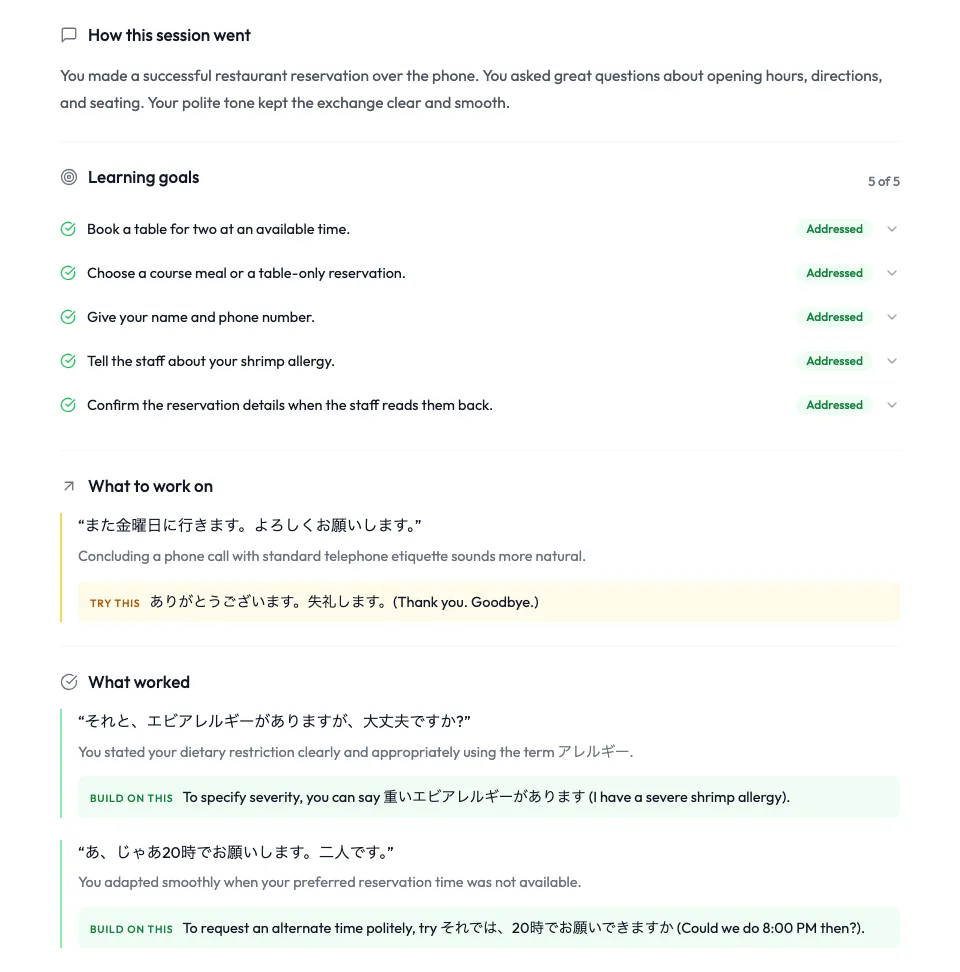
Our team ran this situation in ChitterChatter using the description in the practice section below. A synthetic voice spoke the learner's lines; the AI character's replies and the feedback are what ChitterChatter produced. Here are the first lines of the conversation, lightly trimmed.
Staff
お電話ありがとうございます。
Reading: Odenwa arigatō gozaimasu.
Meaning: Thank you for calling.
You
もしもし、こんばんは。テーブルの予約をしたいです。
Reading: Moshi moshi, konbanwa. Tēburu no yoyaku o shitai desu.
Meaning: Hello, good evening. I'd like to reserve a table.
Staff
ありがとうございます。ご希望の日時はいつでしょうか。
Reading: Arigatō gozaimasu. Gokibō no nichiji wa itsu deshō ka.
Meaning: Thank you. What date and time would you like?
You
えっと、来週の金曜日、夜7時は大丈夫ですか?
Reading: Etto, raishū no kin'yōbi, yoru shichiji wa daijōbu desu ka?
Meaning: Um, is next Friday at 7 in the evening okay?
Staff
来週の金曜日の19時は満席です。18時か20時でしたら空いていますが、いかがでしょうか。
Reading: Raishū no kin'yōbi no jūkuji wa manseki desu. Jūhachiji ka nijūji deshitara aite imasu ga, ikaga deshō ka.
Meaning: Next Friday at 7 p.m. is fully booked. We have tables at 6 or 8 p.m. Would one of those work?
You
あっ、じゃあ20時でお願いします。2人です。
Reading: A, jā nijūji de onegai shimasu. Futari desu.
Meaning: Oh, then 8 p.m., please. It's for two.
Staff
かしこまりました。コースにされますか、それとも席だけにしますか。
Reading: Kashikomarimashita. Kōsu ni saremasu ka, soretomo seki dake ni shimasu ka.
Meaning: Certainly. Would you like a set course, or just a table?
You
席だけでお願いします。それと、エビアレルギーがありますが、大丈夫ですか?
Reading: Seki dake de onegai shimasu. Soreto, ebi arerugī ga arimasu ga, daijōbu desu ka?
Meaning: Just a table, please. Also, I have a shrimp allergy. Is that all right?
Staff
えびアレルギーですね、承知しました。どなたにアレルギーがありますか。厨房で対応しますので、教えてください。
Reading: Ebi arerugī desu ne, shōchi shimashita. Donata ni arerugī ga arimasu ka. Chūbō de taiō shimasu node, oshiete kudasai.
Meaning: A shrimp allergy, understood. Who has the allergy? Please tell us so the kitchen can take care of it.
You
私がエビアレルギーです。料理にエビが入ってないようにお願いします。
Reading: Watashi ga ebi arerugī desu. Ryōri ni ebi ga haitte nai yō ni onegai shimasu.
Meaning: I'm the one with the shrimp allergy. Please make sure there's no shrimp in the food.
Staff
承知しました。えびを使わずに別のものにします。ただ、同じ厨房でえびを扱うので、完全にえびの成分を避けることはできません。ご了承ください。
Reading: Shōchi shimashita. Ebi o tsukawazu ni betsu no mono ni shimasu. Tada, onaji chūbō de ebi o atsukau node, kanzen ni ebi no seibun o sakeru koto wa dekimasen. Goryōshō kudasai.
Meaning: Understood. We'll use something else instead of shrimp. But we handle shrimp in the same kitchen, so we can't completely rule out traces of it. Thank you for understanding.
What the feedback pointed out
What the learner said
あっ、じゃあ20時でお願いします。2人です。
A clearer way to say it
それでは、20時でお願いできますか
You adapted smoothly when the time you wanted was full. To ask for the other time politely, you can say: could we do 8 p.m. then?
What the learner said
料理にエビが入ってないようにお願いします。
A clearer way to say it
エビを抜いていただけますか
You used a negative request pattern accurately to explain your dietary need. You can also politely ask them to leave out the shrimp.
What the learner said
また金曜日に行きます。よろしくお願いします。
A clearer way to say it
ありがとうございます。失礼します。
Ending a phone call with standard telephone etiquette sounds more natural: thank them, then use the usual phrase for hanging up.
Courses, allergies and canceling politely
Course or table only
Many restaurants and izakaya offer reservations for a set course, often with an all-you-can-drink option, 飲み放題 (nomihōdai). Booking 席のみ means you only reserve the table and order freely on the day. Some popular places only take reservations for courses, especially for groups or busy dates, so ask if you're not sure: 席のみの予約はできますか.
Tell them about allergies on the phone
Kitchens can plan around an allergy when they know ahead, especially for a course. Staff may say 確認いたします (let me check) and put you on hold while they ask the kitchen. Some small places will say they can't fully avoid an ingredient, so it's better to know before you go.
Cancel early, and always call
Not showing up without calling, 無断キャンセル (mudan kyanseru), is a real problem for small restaurants that buy food for each booking. Call as soon as you know, apologize, and give your name and booking date. Course reservations often have a cancellation fee close to the day, so ask about it when you book.
Changing the number of people
Call and say 人数が3人に変わったんですが、大丈夫ですか (our group is now three people; is that OK?). It's easier for them to fit an extra person when you tell them early.
Practice the call before you dial
Phone calls are hard because you can't see the person and the numbers go by fast. Rehearse with an AI staff member who answers like a real restaurant, including the read-back.
- Open Create with AI and paste the description below. Change the date, time and group size to the booking you actually need.
- Talk with the AI staff member out loud. When a number goes by too fast, use your repair phrase.
- Check your feedback: which goals you covered, a line you said with a clearer way to say it, and the full transcript, so you can see whether you followed the read-back.
- Try again with a twist: ask them to be full at your first time, or add an allergy.
Describe it like this when you create the activity
Japanese, a phone call to a small restaurant in Tokyo. The AI plays the staff member who answers with the restaurant's name, asks for the date, time, number of people, course or table only, my name and phone number, says my first time is full, and reads everything back. I'm a beginner to intermediate learner and need to book a table for two and mention a shrimp allergy.
Questions learners usually ask first
How do you say "I'd like to make a reservation" in Japanese?
The most common polite way on the phone is 予約をお願いしたいんですが, or the shorter 予約したいんですが. Both end softly, which invites the staff to take over and ask for the details. Start with すみません and you have your whole opening line.
What do Japanese restaurants say when they answer the phone?
Staff usually say お電話ありがとうございます followed by the restaurant's name and でございます, which means "Thank you for calling, this is (name)." They don't say もしもし on a business line. You can reply right away with your request.
What does seki nomi mean when booking a restaurant in Japan?
席のみ means "table only." You reserve the seats without booking a set course, and order from the menu when you arrive. Staff ask this because many restaurants also take course reservations, and some popular places accept bookings for courses only.
Is there a fee to cancel a restaurant reservation in Japan?
It depends on the restaurant. Many places charge nothing if you cancel well ahead, while course bookings and popular restaurants often charge a cancellation fee close to the date. Ask when you book, and if you can't go, always call to cancel rather than just not showing up.