The questions, in the order they usually come
Not every store asks every question, and a busy cashier may skip some or just hold up a bag and look at you. But the order below is what you will hear most of the time at chains like 7-Eleven, FamilyMart and Lawson.
- Heating: 温めますか (atatamemasu ka) for bento boxes, pasta, noodles and other chilled ready meals. They microwave it behind the counter while you pay.
- Chopsticks, spoon or fork: お箸 (ohashi) for noodles and bento, スプーン (supūn) for soup, curry, yogurt or desserts.
- Bag: 袋 (fukuro). Plastic bags have cost a few yen each since July 2020, so you are asked instead of given one.
- Point card or app: ポイントカード (pointo kādo). Saying you don't have one is completely normal.
- Total and payment: the price, then cash, an IC card like Suica, a credit card or a phone payment. Many stores now have you choose and pay on a screen facing you.
- Receipt: レシート (reshīto). Many stores just print it and hand it over or leave it in a small tray, so you may not be asked at all.
What the cashier says
Cashiers use set phrases in polite store Japanese and say them quickly. You only need to catch the key word: 温め, お箸, 袋, ポイント, お支払い, レシート.
こちら温めますか。
Reading: Kochira atatamemasu ka.
Meaning: Shall I heat this up?
Often shortened to just 温めますか, or said with the item's name, like お弁当温めますか.
お箸おつけしますか。
Reading: Ohashi otsukeshimasu ka.
Meaning: Would you like chopsticks with that?
You may also hear スプーンおつけしますか (a spoon) or お箸は何膳おつけしますか (how many pairs of chopsticks).
袋はご利用ですか。
Reading: Fukuro wa goriyō desu ka.
Meaning: Will you be using a bag?
Other versions you will hear: レジ袋お付けしますか and 袋ご入用ですか. They all ask the same thing.
ポイントカードはお持ちですか。
Reading: Pointo kādo wa omochi desu ka.
Meaning: Do you have a point card?
Sometimes the card or app name is used instead of the general word. Either way, it is the same question.
お支払いは画面でお願いします。
Reading: Oshiharai wa gamen de onegaishimasu.
Meaning: Please pay on the screen.
Heard at registers where the cashier scans and you choose your payment method on the screen facing you.
レシートはよろしいですか。
Reading: Reshīto wa yoroshii desu ka.
Meaning: Is it all right without a receipt? (Do you need a receipt?)
This one is easy to answer the wrong way. See the section on the receipt question below.
Short answers that work every time
Shoppers in Japan answer these questions in very few words, so short answers sound natural, not rude. A small nod with your answer is normal.
お願いします。
Reading: Onegaishimasu.
Meaning: Yes, please.
Works for heating, chopsticks, a bag or a spoon. You can add はい in front.
大丈夫です。
Reading: Daijōbu desu.
Meaning: No, thank you. (I'm fine without it.)
Literally "I'm OK." It is the everyday polite way to turn something down, often with a small wave of the hand in front of you. Textbooks may teach a longer refusal, but this is what most people say at the register.
ないです。
Reading: Nai desu.
Meaning: I don't have one.
The answer to the point card question. The textbook form ありません is also fine, and many customers simply say 大丈夫です. ないです is very common in everyday speech.
Suicaでお願いします。
Reading: Suika de onegaishimasu.
Meaning: With Suica, please.
The cashier may ask お支払い方法は (how are you paying?). Swap in カードで (by card) or 現金で (in cash). Other IC cards like PASMO work the same way.
レシートはいらないです。
Reading: Reshīto wa iranai desu.
Meaning: I don't need the receipt.
Clear and polite enough for a shop. If you want it, say ください (please give it to me).
すみません、もう一回いいですか。
Reading: Sumimasen, mō ikkai ii desu ka.
Meaning: Sorry, could you say that once more?
Your repair phrase when you miss a question. Cashiers usually repeat it more slowly or show you the item, the bag or the screen.
The receipt question: why yes and no get confusing
The word よろしいですか means "Is it all right?" So レシートはよろしいですか is usually asking "Is it all right if I don't give you a receipt?" A bare はい can then mean "yes, that's fine, no receipt" or "yes, I want one," and even native speakers sometimes mix it up. The fix is simple: say the thing, not yes or no.
- Don't want it: いらないです or 大丈夫です.
- Want it: ください or お願いします.
- The same trap appears with bags: 袋はよろしいですか is also a question about going without. Answer the same way.
A full checkout: bento at lunchtime
You bring a bento box to the register and pay with Suica on the screen facing you.
Cashier
お弁当、温めますか。
Reading: Obentō, atatamemasu ka.
Meaning: Shall I heat up your bento?
You
はい、お願いします。
Reading: Hai, onegaishimasu.
Meaning: Yes, please.
Cashier
お箸おつけしますか。
Reading: Ohashi otsukeshimasu ka.
Meaning: Would you like chopsticks with that?
You
お願いします。
Reading: Onegaishimasu.
Meaning: Yes, please.
Cashier
袋はご利用ですか。
Reading: Fukuro wa goriyō desu ka.
Meaning: Will you be using a bag?
You
大丈夫です。
Reading: Daijōbu desu.
Meaning: No, thank you.
Cashier
698円です。お支払いは画面でお願いします。
Reading: Roppyaku kyūjūhachi en desu. Oshiharai wa gamen de onegaishimasu.
Meaning: That's 698 yen. Please pay on the screen.
Cashier
レシートはよろしいですか。
Reading: Reshīto wa yoroshii desu ka.
Meaning: Is it all right without a receipt?
You
すみません、もう一回いいですか。
Reading: Sumimasen, mō ikkai ii desu ka.
Meaning: Sorry, could you say that once more?
Cashier
レシート、いりますか。
Reading: Reshīto, irimasu ka.
Meaning: Do you need the receipt?
You
いらないです。
Reading: Iranai desu.
Meaning: I don't need it.
Cashier
ありがとうございました。
Reading: Arigatō gozaimashita.
Meaning: Thank you very much.
The audio uses the AI voice you hear in ChitterChatter conversations.
From a real practice session
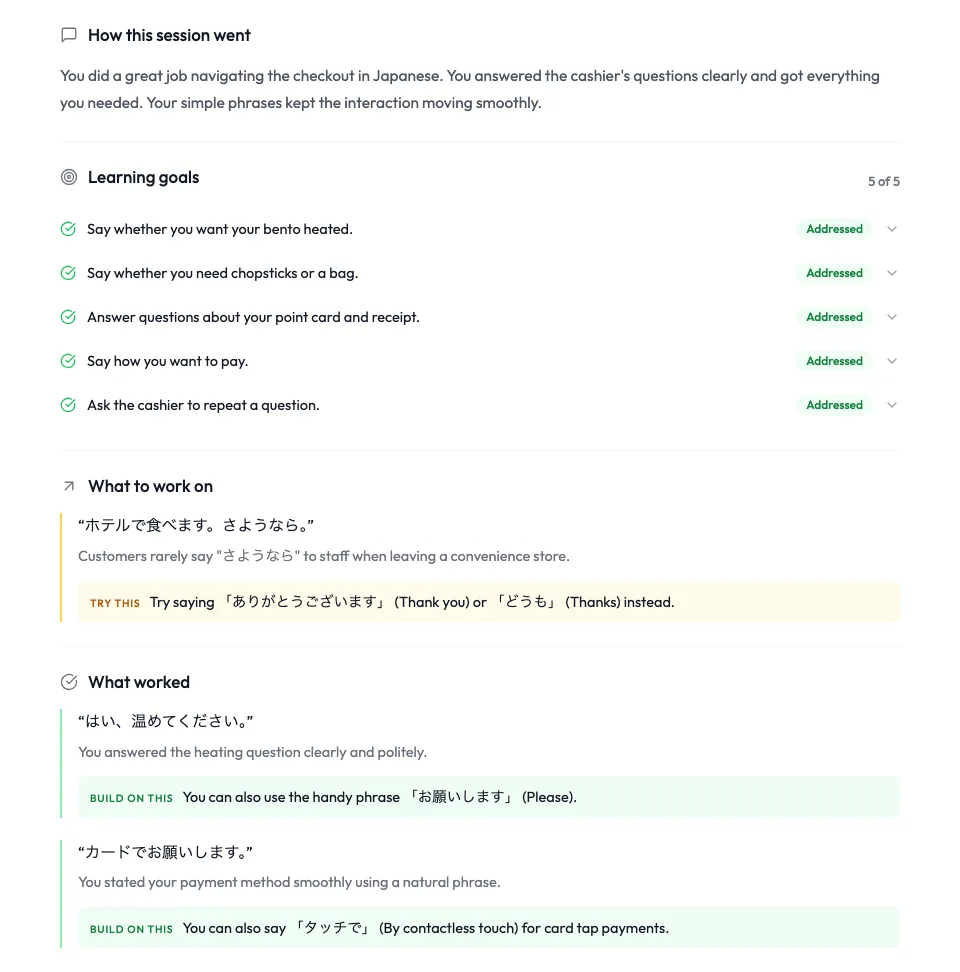
Our team ran this situation in ChitterChatter using the description in the practice section below. A synthetic voice spoke the learner's lines; the AI character's replies and the feedback are what ChitterChatter produced. Here are the first lines of the conversation, lightly trimmed.
Cashier
いらっしゃいませ。お弁当、温めますか。
Reading: Irasshaimase. Obentō, atatamemasu ka.
Meaning: Welcome. Shall I heat up your bento?
You
すみません、もう一度お願いします。
Reading: Sumimasen, mō ichido onegaishimasu.
Meaning: Sorry, could you say that again, please?
Cashier
はい、お弁当、温めますか。
Reading: Hai, obentō, atatamemasu ka.
Meaning: Sure. Shall I heat up your bento?
You
はい、温めてください。
Reading: Hai, atatamete kudasai.
Meaning: Yes, please heat it up.
Cashier
はい、では温めますね。
Reading: Hai, dewa atatamemasu ne.
Meaning: All right, I'll heat it up, then.
You
お願いします。お箸もありますか。
Reading: Onegaishimasu. Ohashi mo arimasu ka.
Meaning: Yes, please. Do you have chopsticks, too?
Cashier
はい、お箸はお付けしますか。
Reading: Hai, ohashi wa otsukeshimasu ka.
Meaning: Yes. Would you like chopsticks with it?
You
はい、お箸ください。それと、すみません、もう一度お願いします。
Reading: Hai, ohashi kudasai. Sore to, sumimasen, mō ichido onegaishimasu.
Meaning: Yes, chopsticks, please. And, sorry, could you say that again?
Cashier
はい、レジ袋はご利用ですか。
Reading: Hai, rejibukuro wa goriyō desu ka.
Meaning: Sure. Will you be using a plastic bag?
You
はい、袋ください。すみません、もう一度お願いします。
Reading: Hai, fukuro kudasai. Sumimasen, mō ichido onegaishimasu.
Meaning: Yes, a bag, please. Sorry, could you say that again?
Cashier
はい、袋は3円です。
Reading: Hai, fukuro wa san en desu.
Meaning: Sure. The bag is 3 yen.
What the feedback pointed out
What the learner said
さようなら。
A clearer way to say it
ありがとうございます。
Customers rarely say this goodbye to staff when leaving a convenience store. A simple thank-you, or a casual thanks, works instead.
What the learner said
ポイントカードはありますか。
A clearer way to say it
ないです。
Cashiers usually ask whether you have a point card before you do. Let the cashier lead that step, wait for the question, and just say you don't have one.
What the learner said
はい、温めてください。
A clearer way to say it
お願いします。
This answered the heating question clearly and politely. The handy all-purpose "please" phrase works for that question too.
What else happens at the register
One item, no bag: the sticker
If you buy just a drink or one small item and say no to a bag, the cashier may ask シールでよろしいですか and put a small store sticker on it to show it was paid for. You can also say このままで大丈夫です (I'll take it as is).
Paying on the screen
At many stores the cashier scans your items, then you pick the payment method on the touch screen facing you. For Suica or PASMO, choose the transit IC option, then hold the card on the reader until it beeps. For cash, many of these registers have you put coins and bills into the machine yourself. If you get stuck, point at the screen and say すみません; the cashier will help. Some stores also have full self-checkout.
Alcohol and cigarettes: the age button
When you buy alcohol or tobacco, the screen asks you to confirm you are 20 or older, the legal age for both in Japan. The cashier will say 画面のタッチをお願いします (please touch the screen). Tap the confirm button. They may also ask for ID if you look young.
Hot and cold in separate bags
If you buy a hot bento and something cold like ice cream, the cashier may ask 袋はお分けしますか (shall I bag them separately?). Answer お願いします or 一緒で大丈夫です (together is fine).
Practice the convenience store register out loud
Reading the questions is one thing. Catching them at full speed is another. Practice with a cashier who asks them the way real staff do, then try again until you answer without thinking.
- Open Create with AI and paste the description below, or write your own version with the items you usually buy.
- Talk with the AI cashier out loud. When you miss a question, use your repair phrase instead of guessing.
- Check your feedback: which goals you covered, a line you said with a clearer way to say it, and the full transcript.
- Run it again with different items, like a drink and ice cream, so you hear the bag, sticker and age questions.
Describe it like this when you create the activity
Japanese, at a convenience store in Tokyo. The AI plays the cashier and asks the usual questions in natural, fast polite Japanese: heating my bento, chopsticks, a bag, a point card, how I'm paying, and the receipt. I'm a beginner and need to answer each question in a few words and ask them to repeat once.
Questions learners usually ask first
What does atatamemasu ka mean at a Japanese convenience store?
It means "Shall I heat this up?" The cashier is offering to microwave your bento, pasta or other ready meal behind the counter, which usually takes a minute or so. Say お願いします for yes or 大丈夫です for no.
How much is a plastic bag at a Japanese convenience store?
Since July 2020, stores across Japan have charged for plastic shopping bags. At convenience stores the price is a few yen, and it varies by bag size and chain. That is why the cashier asks whether you want one instead of bagging your items automatically.
Can I pay with Suica or a credit card at a konbini?
Yes. The major convenience store chains accept IC cards like Suica and PASMO, credit cards and phone payments, and cash is always fine. Tell the cashier how you are paying, or choose it on the screen if the store uses one.
Do I need to reply when konbini staff say irasshaimase?
No. いらっしゃいませ means "welcome," and staff call it out to everyone who walks in. Customers don't answer it. At the register, a word or two per question, a small nod and ありがとうございます at the end are polite and normal.