
How a part-time job interview usually goes
A part-time job is アルバイト (arubaito), usually shortened to バイト (baito). You find the job on a job app or website, or through a スタッフ募集 (staff wanted) sign in a shop window. You apply online or call. Then the store sets a time for the interview, usually with the manager, 店長 (tenchō). You often hear the result by phone within a few days to a week.
- Before: call or apply, agree on a day and time, and ask what to bring.
- At the store: arrive five to ten minutes early and tell the first staff member you see アルバイトの面接に来ました (I'm here for the part-time job interview), then your name.
- The interview: the manager asks the standard questions, checks your residence card, and explains pay and shifts.
- The end: they ask if you have questions, then tell you when they will contact you.
The phone call to set up the interview
Staff answer with the store name, not もしもし. Call at a quiet time, not during the lunch or dinner rush, and have a pen ready to write down the date and time.
お忙しいところすみません。アルバイトの求人を見てお電話しました。
Reading: Oisogashii tokoro sumimasen. Arubaito no kyūjin o mite odenwa shimashita.
Meaning: Sorry to bother you when you're busy. I'm calling about the part-time job ad.
Your opening line. It tells them immediately why you're calling.
担当の方はいらっしゃいますか。
Reading: Tantō no kata wa irasshaimasu ka.
Meaning: Is the person in charge available?
The person who answers is often not the one who hires. If they say the manager is out, ask when to call back.
グエン・ランと申します。
Reading: Guen Ran to mōshimasu.
Meaning: My name is Nguyen Lan.
Say your full name slowly, using the katakana spelling you use at school, because a foreign name is new to the listener. Many Vietnamese students share the family name Nguyen, so at the interview it is fine to add ランと呼んでください (please call me Lan).
では、木曜日の午後3時に伺います。
Reading: Dewa, mokuyōbi no gogo sanji ni ukagaimasu.
Meaning: Then I'll come on Thursday at 3 p.m.
Repeat the day and time back before you hang up. It shows care and catches mistakes.
The questions you will almost certainly hear
Managers usually speak everyday polite Japanese, not formal business language, and often a little faster than your textbook. Prepare one short answer for each of these.
- 何曜日に入れますか (Nan'yōbi ni hairemasu ka): Which days can you work? The verb for working a shift is 入る (to go into a shift).
- 何時から何時まで入れますか (Nanji kara nanji made hairemasu ka): From what time to what time can you work?
- 家からどのくらいかかりますか (Ie kara dono kurai kakarimasu ka): How long does it take you to get here? Many stores pay for train fare, so they want to know how you commute.
- 日本に来てどのくらいですか (Nihon ni kite dono kurai desu ka): How long have you been in Japan?
- 日本語はどのくらい話せますか (Nihongo wa dono kurai hanasemasu ka): How well do you speak Japanese? They may ask about your JLPT level too.
- どうしてここで働きたいと思ったんですか (Dōshite koko de hatarakitai to omotta n desu ka): Why do you want to work here?
- 資格外活動許可は持っていますか (Shikakugai katsudō kyoka wa motte imasu ka): Do you have permission to work?
- いつから働けますか (Itsu kara hatarakemasu ka): When can you start?
Entering, answering and leaving
Being honest about your Japanese is the right call. Managers mostly want to know that you will ask when you don't understand. If you have a JLPT level, say it simply, for example N4を持っています (I have N4).
失礼します。本日はよろしくお願いいたします。
Reading: Shitsurei shimasu. Honjitsu wa yoroshiku onegai itashimasu.
Meaning: Excuse me (as I come in). Thank you for seeing me today.
Say the first part at the door or as you walk up to the table, and the second with a small bow. Wait for どうぞおかけください (please have a seat) before you sit.
月曜日と水曜日の夕方と、土日なら入れます。
Reading: Getsuyōbi to suiyōbi no yūgata to, donichi nara hairemasu.
Meaning: I can work Monday and Wednesday evenings, and weekends.
Be specific. A clear list of days and hours is what the manager needs to build the shift schedule.
日本語はまだ勉強中ですが、わからないときは必ず確認します。
Reading: Nihongo wa mada benkyōchū desu ga, wakaranai toki wa kanarazu kakunin shimasu.
Meaning: I'm still learning Japanese, but when I don't understand something, I always check.
An honest answer with a plan. It works much better than saying your Japanese is fine and then struggling.
資格外活動許可は持っています。
Reading: Shikakugai katsudō kyoka wa motte imasu.
Meaning: I have permission to work.
Have your residence card ready. The permission is shown on the back, and they will usually ask to see or copy both sides.
すみません、もう少しゆっくり話していただけますか。
Reading: Sumimasen, mō sukoshi yukkuri hanashite itadakemasu ka.
Meaning: Sorry, could you speak a little more slowly?
Your repair phrase. Asking politely shows exactly the habit the manager is hoping for.
研修はありますか。
Reading: Kenshū wa arimasu ka.
Meaning: Is there training?
A good question to ask at the end. It shows you want to do the job properly.
シフトはどのように決まりますか。
Reading: Shifuto wa dono yō ni kimarimasu ka.
Meaning: How are shifts decided?
Some stores fix your days, others ask you to submit the days you can work every week or two.
本日はありがとうございました。失礼いたします。
Reading: Honjitsu wa arigatō gozaimashita. Shitsurei itashimasu.
Meaning: Thank you for today. Goodbye (excuse me as I leave).
Stand up, bow, and say this before you leave the room or the table.
An interview at a neighborhood restaurant
You are a language school student. The manager meets you at a table in the restaurant before evening opening.
Manager
どうぞ、おかけください。
Reading: Dōzo, okake kudasai.
Meaning: Please, have a seat.
You
失礼します。
Reading: Shitsurei shimasu.
Meaning: Thank you. (Excuse me.)
Manager
日本に来てどのくらいですか。
Reading: Nihon ni kite dono kurai desu ka.
Meaning: How long have you been in Japan?
You
半年くらいです。今、日本語学校に通っています。
Reading: Hantoshi kurai desu. Ima, Nihongo gakkō ni kayotte imasu.
Meaning: About six months. I'm going to a Japanese language school now.
Manager
学校は午前ですか、午後ですか。
Reading: Gakkō wa gozen desu ka, gogo desu ka.
Meaning: Are your classes in the morning or the afternoon?
You
午前です。午後2時からなら入れます。
Reading: Gozen desu. Gogo niji kara nara hairemasu.
Meaning: In the morning. I can work from 2 p.m.
Manager
週に何日くらい入れそうですか。
Reading: Shū ni nannichi kurai hairesō desu ka.
Meaning: About how many days a week do you think you can work?
You
週4日くらい入りたいです。
Reading: Shū yokka kurai hairitai desu.
Meaning: I'd like to work about four days a week.
Manager
家からどのくらいかかりますか。
Reading: Ie kara dono kurai kakarimasu ka.
Meaning: How long does it take from your home?
You
自転車で10分くらいです。
Reading: Jitensha de juppun kurai desu.
Meaning: About ten minutes by bike.
Manager
どうしてうちの店を選んだんですか。
Reading: Dōshite uchi no mise o eranda n desu ka.
Meaning: Why did you choose our restaurant?
You
家から近いですし、お客さんと話して日本語を使えるようになりたいと思ったからです。
Reading: Ie kara chikai desu shi, okyakusan to hanashite Nihongo o tsukaeru yō ni naritai to omotta kara desu.
Meaning: It's close to home, and I want to get better at using Japanese by talking with customers.
The audio uses the AI voice you hear in ChitterChatter conversations.
From a real practice session
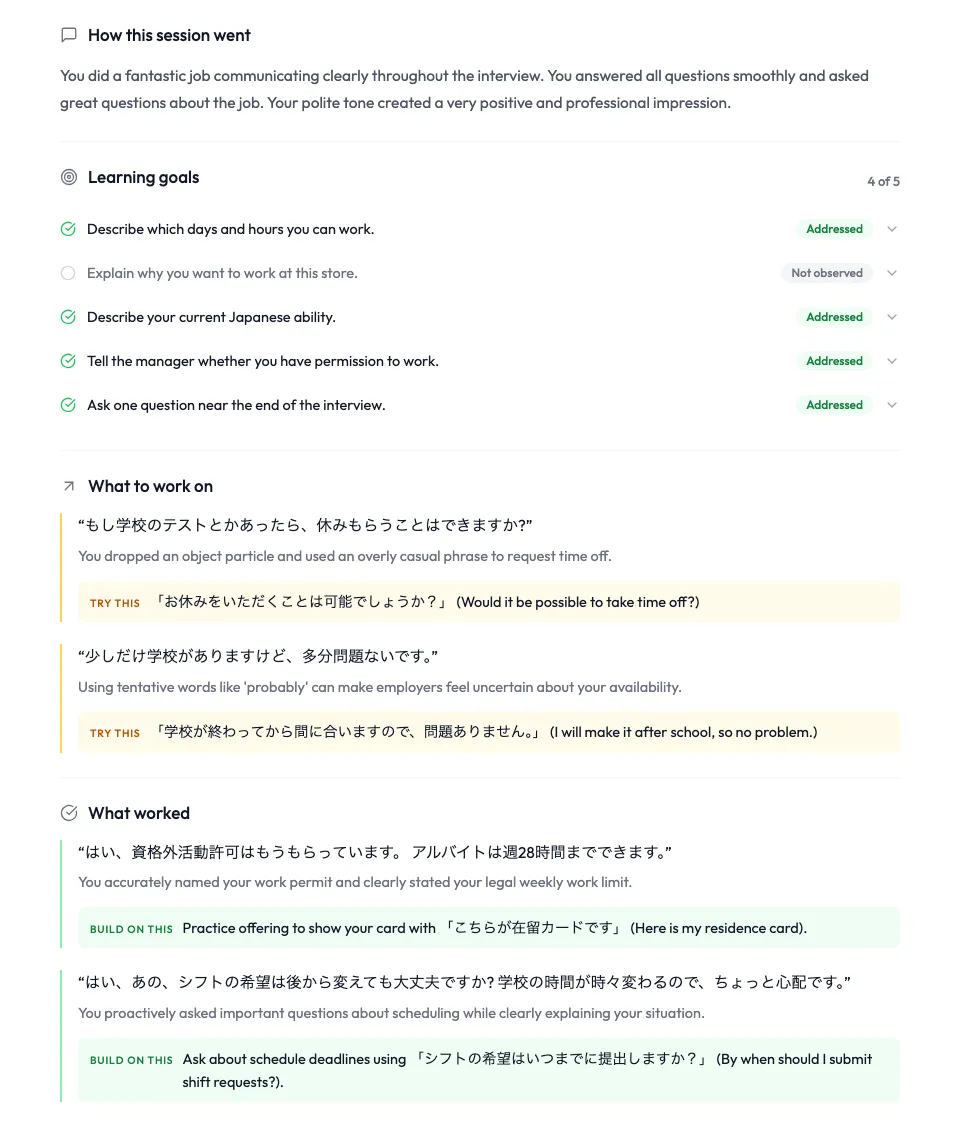
Our team ran this situation in ChitterChatter using the description in the practice section below. A synthetic voice spoke the learner's lines; the AI character's replies and the feedback are what ChitterChatter produced. Here are the first lines of the conversation, lightly trimmed.
Manager
こんにちは。どうぞ、おかけください。今日はよろしくお願いします。
Reading: Konnichiwa. Dōzo, okake kudasai. Kyō wa yoroshiku onegai shimasu.
Meaning: Hello. Please, have a seat. Thank you for coming in today.
You
こんにちは。今日はよろしくおねがいします。あの、私は月曜日と水曜日と金曜日、午後5時から10時まで働くことができます。
Reading: Konnichiwa. Kyō wa yoroshiku onegai shimasu. Ano, watashi wa getsuyōbi to suiyōbi to kin'yōbi, gogo goji kara jūji made hataraku koto ga dekimasu.
Meaning: Hello. Thank you for seeing me today. Um, I can work Mondays, Wednesdays and Fridays, from 5 to 10 p.m.
Manager
ありがとうございます。こちらの空きは火曜と木曜の17時から21時、それから土曜の9時から13時なんです。週に二日くらいですが、その時間帯はどうですか。
Reading: Arigatō gozaimasu. Kochira no aki wa kayō to mokuyō no jūshichiji kara nijūichiji, sorekara doyō no kuji kara jūsanji na n desu. Shū ni futsuka kurai desu ga, sono jikantai wa dō desu ka.
Meaning: Thank you. Our open shifts are Tuesday and Thursday from 5 to 9 p.m., and Saturday from 9 a.m. to 1 p.m. It's about two days a week. How do those hours work for you?
You
はい、大丈夫です。火曜日と木曜日の5時から9時、それと土曜日の9時から1時も働けます。少しだけ学校がありますけど、たぶん問題ないです。
Reading: Hai, daijōbu desu. Kayōbi to mokuyōbi no goji kara kuji, sore to doyōbi no kuji kara ichiji mo hatarakemasu. Sukoshi dake gakkō ga arimasu kedo, tabun mondai nai desu.
Meaning: Yes, that's fine. I can work Tuesdays and Thursdays from 5 to 9, and Saturdays from 9 to 1 too. I do have some classes, but it's probably not a problem.
Manager
わかりました、助かります。通勤はどうされますか。電車とか、自転車とか。
Reading: Wakarimashita, tasukarimasu. Tsūkin wa dō saremasu ka. Densha to ka, jitensha to ka.
Meaning: Got it, that really helps. How will you get here? By train, by bike?
You
はい、学校から歩いて10分ぐらいなので、歩いて来ます。雨の日はバスで来ることもあります。
Reading: Hai, gakkō kara aruite juppun gurai na node, aruite kimasu. Ame no hi wa basu de kuru koto mo arimasu.
Meaning: Yes, it's about a ten-minute walk from my school, so I'll walk. On rainy days I sometimes take the bus.
Manager
歩いて10分なら通いやすいですね。日本にはどれくらい住んでいますか。
Reading: Aruite juppun nara kayoiyasui desu ne. Nihon ni wa dore kurai sunde imasu ka.
Meaning: A ten-minute walk makes for an easy commute. How long have you lived in Japan?
You
日本に来て、まだ8か月ぐらいです。日本語は、まだ上手じゃないですが、がんばって勉強しています。
Reading: Nihon ni kite, mada hachikagetsu gurai desu. Nihongo wa, mada jōzu ja nai desu ga, ganbatte benkyō shite imasu.
Meaning: I've only been in Japan about eight months. My Japanese isn't good yet, but I'm studying hard.
Manager
そうなんですね。日常会話はできますか。
Reading: Sō na n desu ne. Nichijō kaiwa wa dekimasu ka.
Meaning: I see. Can you handle everyday conversation?
You
はい、日常会話はできます。でも、むずかしい言葉はまだよく分からないです。コンビニの日本語も、もっと勉強したいです。
Reading: Hai, nichijō kaiwa wa dekimasu. Demo, muzukashii kotoba wa mada yoku wakaranai desu. Konbini no Nihongo mo, motto benkyō shitai desu.
Meaning: Yes, I can handle everyday conversation. But I still don't really understand difficult words. I also want to learn more of the Japanese used at convenience stores.
Manager
その意欲はいいですね。ここではゆっくり話しますので、わからないときは聞き返して大丈夫です。もし聞き取れなかったら、どうしますか。
Reading: Sono iyoku wa ii desu ne. Koko de wa yukkuri hanashimasu node, wakaranai toki wa kikikaeshite daijōbu desu. Moshi kikitorenakattara, dō shimasu ka.
Meaning: I like that motivation. We'll speak slowly here, so it's fine to ask again when you don't understand. If you couldn't catch something, what would you do?
You
はい、すみませんが、もう一度ゆっくり言っていただけますか、と言います。それか、メモしてもいいですかと聞きます。
Reading: Hai, sumimasen ga, mō ichido yukkuri itte itadakemasu ka, to iimasu. Sore ka, memo shite mo ii desu ka to kikimasu.
Meaning: Yes, I'd say, "Excuse me, could you say that again slowly?" Or I'd ask if I could take notes.
What the feedback pointed out
What the learner said
もし学校のテストとかあったら、休みもらうことはできますか?
A clearer way to say it
お休みをいただくことは可能でしょうか?
The feedback said you dropped an object particle and used an overly casual phrase to ask for time off. The suggestion is a more polite way to ask whether taking time off would be possible.
What the learner said
少しだけ学校がありますけど、たぶん問題ないです。
A clearer way to say it
学校が終わってから間に合いますので、問題ありません。
Saying "probably" can make an employer feel unsure about your availability. The suggestion says plainly that you will make it after school, so there is no problem.
What the learner said
はい、資格外活動許可はもうもらっています。アルバイトは週28時間までできます。
A clearer way to say it
こちらが在留カードです
This was something that worked: you named your work permit correctly and clearly stated your weekly limit on work hours. As a next step, the feedback suggested practicing how to offer to show your residence card.
Work permission: what interviewers check
Student residence status does not by itself include the right to work. To take a part-time job you need permission to engage in activity other than that permitted, 資格外活動許可 (shikakugai katsudō kyoka). Many students apply for it at the airport when they first arrive, and others apply later at an immigration office. Once it is granted, it is noted on the back of your residence card, and employers are expected to check it.
- The limit generally stated for students is 28 hours a week in total while school is in session, counting all your jobs together, not per job.
- During your school's official long vacations, the generally stated limit is up to 8 hours a day. This means the vacation periods your school sets, not days when you simply have no class.
- Some kinds of work, such as hostess bars and certain entertainment businesses, are not allowed for students at all.
- Rules and how they apply to you can change, and this is not legal advice. Confirm with your school's international student office or the Immigration Services Agency of Japan before you agree to your hours.
Small things that make a good impression
Ask what to bring
Some stores want a 履歴書 (Japanese-style resume with a photo), while many chains that take online applications don't. Ask on the phone: 履歴書は必要ですか (Do I need a resume?). Bring your residence card either way.
Mention trips home and exams early
If you plan to go home for a holiday such as Lunar New Year, or have exam weeks when you can't work, say so in the interview. For example: 2月に2週間ほど帰国する予定です (I plan to go home for about two weeks in February). Managers plan shifts weeks ahead and appreciate knowing.
Have one question ready
Answering 特にありません (nothing in particular) when they ask for your questions can sound uninterested. Ask about training or shifts, or simply 結果はいつごろわかりますか (about when will I hear the result?).
Simple, clean clothes are enough
For most part-time job interviews you don't need a suit. Neat, plain clothes are fine. Put your phone on silent and keep it in your bag.
Rehearse your interview out loud
The questions are predictable, so the best preparation is answering them aloud until your answers come easily, and practicing what to say when you don't catch a question.
- Open Create with AI and paste the description below. Change the store type, your school schedule and your Japanese level to match you.
- Talk with the AI manager out loud. Use your repair phrase when a question is too fast.
- Review your feedback: which goals you covered, a line you said with a clearer way to say it, and the full transcript. Ask the AI Coach about any suggestion.
- Run the interview again and add one question of your own at the end.
Describe it like this when you create the activity
Japanese, a part-time job interview at a convenience store in Tokyo. The AI plays the store manager and asks the usual questions: which days and hours I can work, my commute, how long I've been in Japan, my Japanese level, why this store, and whether I have permission to work. I'm an international student at a language school with beginner to intermediate Japanese, and I need to answer politely and ask one question at the end.
Questions learners usually ask first
What questions are asked in a part-time job interview in Japan?
Almost every part-time job interview covers which days and hours you can work, how you get to the store, how long you have been in Japan, how well you speak Japanese, and why you chose the store. International students are also asked about their permission to work. At the end you are usually asked if you have any questions.
How many hours can international students work part-time in Japan?
The limit generally stated for students with work permission is 28 hours a week in total across all jobs while school is in session, and up to 8 hours a day during the school's official long vacations. You need the permission (資格外活動許可) before you start. Rules can change and depend on your situation, so confirm with your school or the Immigration Services Agency of Japan.
Do I need a rirekisho for a part-time job in Japan?
It depends on the store. Some ask for a Japanese-style resume (履歴書) with a photo, while many chains that take online applications don't need one. Ask when you set up the interview, and bring your residence card either way.
How good does my Japanese need to be for a part-time job in Japan?
It depends on the job. Jobs with lots of customer contact, like cashier or floor staff, need everyday spoken Japanese, while kitchen, warehouse and cleaning jobs usually need less. Be honest about your level in the interview and show that you ask when you don't understand. Practicing the interview out loud, for example in a ChitterChatter voice conversation, helps your answers come out smoothly.