The order staff expect, in one breath
Shops take orders in the same sequence the drink is made: the drink and size, then sweetness, then ice, then any toppings. Say it in that sequence and you will rarely get a follow-up question. A complete order can be as short as 一杯珍奶,大杯,半糖少冰. In the phrases on this page, sugar always comes before ice, the way staff write it on the cup sticker.
- Cup sizes are usually 中杯 (zhōng bēi, medium) and 大杯 (dà bēi, large). Some shops in Taiwan only sell one size, and a few chains add 超大杯 (chāo dà bēi, extra large).
- In Taiwan, pearl milk tea is usually shortened to 珍奶 (zhēnnǎi). In mainland China, people more often say the full 珍珠奶茶 (zhēnzhū nǎichá).
- The phrases and dialogue on this page use simplified characters, as in mainland China. Menus in Taiwan use traditional characters, so 常温 appears as 常溫, 外带 as 外帶, and 奶盖 as 奶蓋. They sound the same. Words shown only as they appear on Taiwan menus are written in traditional characters.
Phrases for the drink itself
These cover the main part of any order. Each phrase works on its own, so you can answer the cashier's questions one at a time.
我要一杯珍珠奶茶,大杯。
Reading: Wǒ yào yì bēi zhēnzhū nǎichá, dà bēi.
Meaning: I'd like a pearl milk tea, large.
Casual and normal in both places. 一 is pronounced yì before 杯, not yī.
半糖少冰。
Reading: Bàn táng shǎo bīng.
Meaning: Half sugar, less ice.
A very common custom order, understood in both places. Staff may repeat it back to you as a check.
三分糖,去冰。
Reading: Sān fēn táng, qù bīng.
Meaning: Thirty percent sugar, no ice.
Mainland style. 分 here means tenths, so 三分糖 is three tenths of the normal sugar and 五分糖 is half.
微糖去冰。
Reading: Wēi táng qù bīng.
Meaning: Light sugar, no ice.
Taiwan style. At many shops in Taiwan, 微糖 is about a third of the normal sugar, but each shop sets its own levels.
常温就好。
Reading: Chángwēn jiù hǎo.
Meaning: Room temperature is fine.
For when you want no ice and no chill. Written 常溫 in Taiwan. You can also ask for 温的 (wēn de, warm) or 热的 (rè de, hot), though not every drink can be made hot.
不要珍珠,换成椰果。
Reading: Bú yào zhēnzhū, huànchéng yēguǒ.
Meaning: No pearls; switch them to coconut jelly.
Note the tone change: 不 becomes bú before a fourth-tone word like 要. Some shops charge a little extra for a swap.
加一份布丁。
Reading: Jiā yí fèn bùdīng.
Meaning: Add a serving of pudding.
Use 加 (jiā, add) for any extra topping. 一 becomes yí before the fourth-tone 份.
Sugar and ice: Taiwan labels vs mainland labels
Both places offer the same idea, a scale from full sugar to none and from full ice to hot, but the labels differ. Shops set their own levels, so treat the percentages below as typical, not fixed. Both styles now turn up in both places, especially at chains that operate on both sides.
- Taiwan sweetness, sweetest first: 正常糖 or 全糖 (full), 少糖 (about 70 to 80 percent), 半糖 (half), 微糖 (about 30 percent), 一分糖 (about 10 percent), 無糖 (none).
- Mainland sweetness at many chains: 标准糖 or 正常糖 (full), 七分糖, 五分糖, 三分糖, and 不另外加糖 (no added sugar). Some chains use words instead, such as 少甜 and 少少甜.
- Ice, most first, in both places: 正常冰 (regular), 少冰 (less), 微冰 (just a little, more common in Taiwan), 去冰 (no ice cubes), then 常温, 温, and 热.
- Taiwan shops often add 完全去冰 (wánquán qù bīng). At many shops, a plain no-ice drink is still shaken with ice and strained, or may keep a few cubes. This option asks for no ice at all, so the drink is less cold.
- No added sugar is not the same as not sweet. Fruit teas and some milk bases are sweet already, and toppings like pearls are often soaked in syrup.
What the cashier will ask, and how fast
Staff at busy shops compress their questions into a few words, often with no question word at all. If you know these, the speed stops being a problem.
- 甜度冰塊? (Tiándù bīngkuài?) is the Taiwan classic: sweetness and ice, please. Answer with two labels, such as 微糖去冰.
- 几分糖? (Jǐ fēn táng?) is common in mainland China: how many tenths of sugar? Answer with a number, such as 五分.
- 冰的还是热的? (Bīng de háishi rè de?) means iced or hot. Answer 冰的, 热的, or 去冰.
- 要加料吗? (Yào jiā liào ma?) means do you want toppings. If not, say 不用.
- In Taiwan you may hear 內用還是外帶? (dine in or takeout?). In mainland China it is 堂食还是带走? (Tángshí háishi dàizǒu?). Many drink shops in Taiwan are takeout only and skip this question.
- 要袋子吗? (Yào dàizi ma?) means do you want a bag. In Taiwan, drink shops generally have to charge for plastic bags, so a bag costs a small fee.
Phrases for pickup, bags, and getting unstuck
If the cashier speaks too fast or a menu word stops you, a short repair phrase keeps the order moving. 不好意思 (bù hǎoyìsi) is a soft excuse me that works with any of them.
带走,谢谢。
Reading: Dàizǒu, xièxie.
Meaning: To go, thanks.
Mainland. In Taiwan, say 外帶 (wàidài). For dine in, it is 堂食 in mainland China and 內用 (nèiyòng) in Taiwan.
不用袋子,谢谢。
Reading: Bú yòng dàizi, xièxie.
Meaning: No bag, thanks.
Handy in Taiwan, where bags cost extra. 不 is bú here because 用 is fourth tone.
不好意思,可以说慢一点吗?
Reading: Bù hǎoyìsi, kěyǐ shuō màn yìdiǎn ma?
Meaning: Sorry, could you say that a bit more slowly?
Polite and friendly. Staff will usually repeat the question more slowly, often in fuller words.
三分糖大概多甜?
Reading: Sān fēn táng dàgài duō tián?
Meaning: Roughly how sweet is thirty percent sugar?
Swap in any label you don't know, such as 微糖. Staff hear this question all the time.
有什么推荐的吗?
Reading: Yǒu shénme tuījiàn de ma?
Meaning: Do you have anything you'd recommend?
Good at a new shop or a seasonal menu. Staff will often point to the drink the shop is known for.
At the counter in Taipei
A customer orders at a busy tea shop in Taipei. The cashier asks the sweetness and ice question quickly, and the customer asks her to slow down. Written in simplified characters; the menu on the wall would use traditional ones.
Cashier
你好,请问要喝什么?
Reading: Nǐ hǎo, qǐngwèn yào hē shénme?
Meaning: Hi, what would you like to drink?
You
一杯珍奶,大杯。
Reading: Yì bēi zhēnnǎi, dà bēi.
Meaning: A pearl milk tea, large.
Cashier
甜度冰块?
Reading: Tiándù bīngkuài?
Meaning: Sweetness and ice?
You
不好意思,可以说慢一点吗?
Reading: Bù hǎoyìsi, kěyǐ shuō màn yìdiǎn ma?
Meaning: Sorry, could you say that a bit more slowly?
Cashier
甜度跟冰块,要怎么调?
Reading: Tiándù gēn bīngkuài, yào zěnme tiáo?
Meaning: The sweetness and the ice: how would you like them?
You
微糖去冰。
Reading: Wēi táng qù bīng.
Meaning: Light sugar, no ice.
Cashier
好。要加料吗?
Reading: Hǎo. Yào jiā liào ma?
Meaning: Okay. Any extra toppings?
You
加一份布丁。
Reading: Jiā yí fèn bùdīng.
Meaning: Add a serving of pudding.
Cashier
要袋子吗?袋子要另外收费哦。
Reading: Yào dàizi ma? Dàizi yào lìngwài shōufèi o.
Meaning: Do you want a bag? Bags cost extra.
You
不用,谢谢。
Reading: Bú yòng, xièxie.
Meaning: No, thanks.
The audio uses the AI voice you hear in ChitterChatter conversations.
From a real practice session
Our team ran this situation in ChitterChatter using the description in the practice section below. A synthetic voice spoke the learner's lines; the AI character's replies and the feedback are what ChitterChatter produced. Here are the first lines of the conversation, lightly trimmed. The session was set in a Taipei shop, so it is written in traditional characters, as used in Taiwan.
Cashier
你好,喝什麼?
Reading: Nǐ hǎo, hē shénme?
Meaning: Hi, what would you like to drink?
You
我要一杯珍珠奶茶,中杯。
Reading: Wǒ yào yì bēi zhēnzhū nǎichá, zhōng bēi.
Meaning: I'd like a pearl milk tea, medium.
Cashier
好,中杯珍珠奶茶,甜度?冰塊?
Reading: Hǎo, zhōng bēi zhēnzhū nǎichá, tiándù? Bīngkuài?
Meaning: Okay, a medium pearl milk tea. Sweetness? Ice?
You
半糖,少冰。
Reading: Bàn táng, shǎo bīng.
Meaning: Half sugar, less ice.
Cashier
好的,半糖少冰。要加其他料嗎?
Reading: Hǎo de, bàn táng shǎo bīng. Yào jiā qítā liào ma?
Meaning: Okay, half sugar, less ice. Would you like any other toppings?
You
我要加椰果,謝謝。
Reading: Wǒ yào jiā yēguǒ, xièxie.
Meaning: I'd like to add coconut jelly, thanks.
Cashier
好,加椰果。要袋子嗎?
Reading: Hǎo, jiā yēguǒ. Yào dàizi ma?
Meaning: Okay, coconut jelly added. Do you want a bag?
You
不用袋子,謝謝。這個奶茶有咖啡嗎?
Reading: Bú yòng dàizi, xièxie. Zhège nǎichá yǒu kāfēi ma?
Meaning: No bag, thanks. Does this milk tea have coffee in it?
Cashier
沒有咖啡,就是茶和奶。
Reading: Méiyǒu kāfēi, jiù shì chá hé nǎi.
Meaning: No coffee. It's just tea and milk.
You
喔,好。那這個可以外帶嗎?
Reading: Ō, hǎo. Nà zhège kěyǐ wàidài ma?
Meaning: Oh, okay. Can I get it to go?
Cashier
可以,都是外帶,大概五分鐘。
Reading: Kěyǐ, dōu shì wàidài, dàgài wǔ fēnzhōng.
Meaning: Sure, everything here is to go. It'll be about five minutes.
What the feedback pointed out
What the learner said
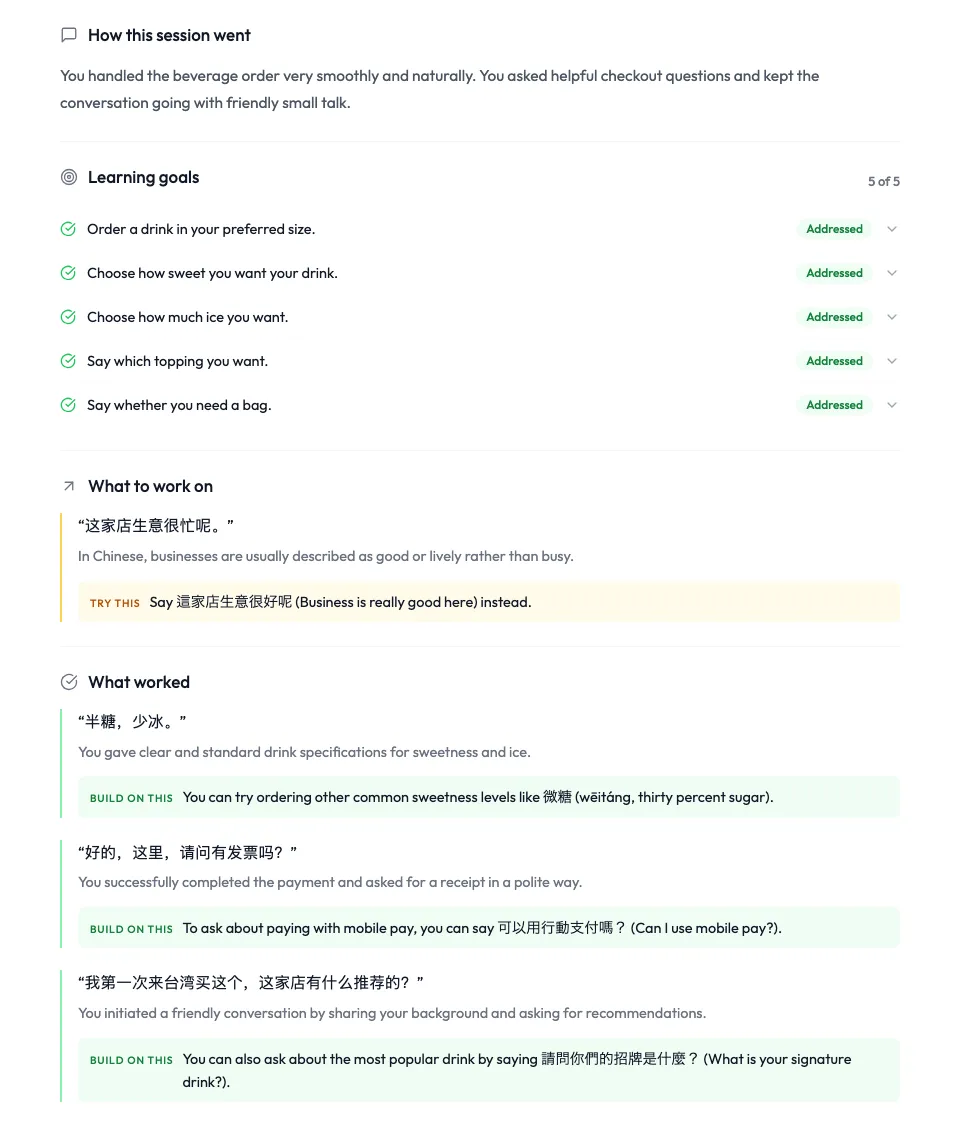
半糖,少冰。
A clearer way to say it
微糖
Your sweetness and ice choices were clear and standard. You can also try ordering other common sweetness levels, such as light sugar, which is about thirty percent sugar.
What the learner said
不用袋子,謝謝。
A clearer way to say it
我自己有袋子
You answered the question about a bag quickly and clearly. If you bring your own bag, you can say that you have your own bag.
What the learner said
我第一次來台灣買這個,這家店有什麼推薦的?
A clearer way to say it
請問你們的招牌是什麼?
You started a friendly chat by sharing that it was your first time and asking for recommendations. You can also ask about the most popular drink by asking what the shop's signature drink is.
Ordering by QR code or app in mainland China
At many mainland chains, the counter is mostly for pickup. You scan the QR code on the counter or table, and the shop's mini program opens inside your payment app. The menu walks you through the same choices a cashier would ask about, then you pay and wait for your number.
- The options are usually grouped as 规格 (guīgé, size), 温度 (wēndù, temperature or ice), 甜度 (tiándù, sweetness), and 加料 (jiā liào, toppings).
- Your pickup number is the 取餐码 (qǔcān mǎ). It shows on your phone and often on a screen in the shop. Staff may call it out, for example 八十六号 (bāshíliù hào, number 86).
- You can still order out loud at the counter at most shops. If staff point you to the QR code, ask 可以直接点吗? (Kěyǐ zhíjiē diǎn ma?) to check whether you can just order with them.
- In Taiwan, most shops still take orders at the counter and print a sticker for your cup. Some chains also offer app or online ordering for pickup.
Small things that trip up learners
Two tone changes you will use in every order
一 is yì before first, second, and third tones (一杯, yì bēi) and yí before a fourth tone (一份, yí fèn). 不 is bú before a fourth tone (不要, 不用) and bù elsewhere (不加, bù jiā). Dictionaries usually write the original tone, but people say the changed one, and the readings on this page show it.
Pearls are not always the same pearls
At many shops in Taiwan, 波霸 (bōbà) means the larger tapioca pearls and 珍珠 the smaller ones, and a menu may list both. Elsewhere, 珍珠 is simply the general word. Other common toppings include 椰果 (coconut jelly), 布丁 (pudding), 仙草 (xiāncǎo, grass jelly), 芋圆 (yùyuán, taro balls), and 奶盖 (nǎigài, a salted cream foam on top).
Bring your own cup in Taiwan
Chain drink shops in Taiwan are required to give a small discount if you bring your own cup. Hand the cup over as you order and say 我有帶環保杯 (wǒ yǒu dài huánbǎo bēi, I brought my own reusable cup).
Practice the order out loud
The fast sweetness and ice question is the part learners freeze on, so rehearse it until your answer comes out without thinking. Practice once with Taiwan labels and once with mainland labels.
- Open Create with AI and paste the description below, or change the city and the drink you want.
- Talk with the AI cashier out loud. Answer each question in a word or two, the way you would at a real counter.
- Check the feedback for the learning goals you covered and the clearer way to say one of your lines. Ask the AI Coach about any label you weren't sure of.
- Run it again with a different sugar level, ice level, and topping, until the order comes out in one breath.
Describe it like this when you create the activity
I want to practice ordering bubble tea in Mandarin Chinese at a busy tea shop in Taipei. You are the cashier: ask what I want and what size, then ask sweetness and ice in two quick words the way real staff do, then toppings and whether I want a bag. I'm a beginner, so keep your questions short.
Questions learners usually ask first
What does 去冰 mean, and how is it different from 少冰?
去冰 means no ice cubes in your cup, while 少冰 means less ice than usual. At many shops a 去冰 drink is still cold, because it is shaken with ice before serving, and some cups may still have a few cubes. In Taiwan, 完全去冰 asks for no ice at all, and 常温 (room temperature) means neither iced nor chilled.
How do you say half sugar, less ice in Chinese?
Say 半糖少冰. It works in both Taiwan and mainland China. At mainland chains that count in tenths, 五分糖少冰 means the same thing.
What is the difference between 珍珠 and 波霸?
Both are tapioca pearls. At many shops in Taiwan, 波霸 are the larger pearls and 珍珠 the smaller ones. In mainland China and many other places, 珍珠 is just the general word, and most shops serve one kind.
Do I need WeChat to order bubble tea in China?
Not always. Many mainland chains expect you to scan a QR code and order in a mini program inside WeChat or Alipay, and both apps now accept many foreign cards. At most shops you can still order out loud at the counter, though you may need a mobile payment app to pay.