Getting a server's attention
Servers at Korean barbecue places usually don't hover. You call them when you need something, and doing so out loud is normal, not rude. Many places now also have a call button or a tablet on the table for ordering.
- 저기요, jeogiyo: the safe choice anywhere. It literally means something like excuse me, over there, and works for any server of any age.
- 여기요, yeogiyo: over here. Just as common and just as polite.
- 사장님, sajangnim: literally boss or owner. At small, casual places, many customers use it for the owner and often for any staff member, as a friendly, respectful way to call them.
- 이모, imo: literally aunt, used by many diners for middle-aged women working at casual restaurants. It sounds warm to some people and too familiar to others, so as a learner, stick with 저기요 or 사장님.
Ordering the meat
Meat is ordered by the serving: 1인분, irinbun, is one serving, 2인분, i-inbun, is two, and 3인분, saminbun, is three. Use Sino-Korean numbers with it.
저기요!
Reading: Jeogiyo!
Meaning: Excuse me!
Say it clearly enough to be heard across the room. Raising a hand at the same time helps.
사장님, 주문할게요.
Reading: Sajangnim, jumunhalgeyo.
Meaning: We'd like to order, please.
A natural way to start an order once someone comes over.
삼겹살 2인분 주세요.
Reading: Samgyeopsal i-inbun juseyo.
Meaning: Two servings of pork belly, please.
Swap in other cuts: 목살, moksal, pork neck; 항정살, hangjeongsal, pork jowl; 차돌박이, chadolbagi, thin-sliced beef brisket.
1인분도 주문돼요?
Reading: Irinbundo jumundwaeyo?
Meaning: Can I order just one serving?
Ask this at the door if you're eating alone or want a small amount. Many barbecue places only take two servings or more, at least on the first order.
Refills, the grill, the rice course and the bill
Side dishes and lettuce are part of the meal, and asking for more is completely normal. Some restaurants bring refills to the table; others have a self-serve bar.
상추 좀 더 주실 수 있어요?
Reading: Sangchu jom deo jusil su isseoyo?
Meaning: Could we get some more lettuce?
Works for anything: replace 상추 with 김치, gimchi, or 반찬, banchan, side dishes.
불판 좀 갈아 주세요.
Reading: Bulpan jom gara juseyo.
Meaning: Could you change the grill plate, please?
Ask when the plate gets blackened or sticky. Staff usually swap it for a clean one at no charge.
공기밥 하나랑 된장찌개 하나 주세요.
Reading: Gonggibap hanarang doenjangjjigae hana juseyo.
Meaning: One bowl of rice and one soybean paste stew, please.
Many people order these partway through or right after the meat. Menus almost always write 공기밥, a bowl of rice, though the dictionary spelling is 공깃밥; both are said the same way.
물냉면 하나, 비빔냉면 하나 주세요.
Reading: Mullaengmyeon hana, bibimnaengmyeon hana juseyo.
Meaning: One cold noodle soup and one spicy cold noodles, please.
Cold noodles after grilled meat is a classic way to finish, especially in summer. Not every barbecue place serves them, so check the menu.
따로 계산해도 될까요?
Reading: Ttaro gyesanhaedo doelkkayo?
Meaning: Is it okay if we pay separately?
Ask at the counter. Most places will split it, though some prefer one payment when they are busy.
죄송한데 한 번만 더 말씀해 주세요.
Reading: Joesonghande han beonman deo malsseumhae juseyo.
Meaning: Sorry, could you say that one more time?
Your repair phrase. Restaurants are loud, so staff are used to repeating themselves.
Ordering for two
A busy pork barbecue place in Seoul in the evening. You sit down with a friend and call the owner over. Polite speech throughout.
You
사장님, 주문할게요.
Reading: Sajangnim, jumunhalgeyo.
Meaning: We'd like to order, please.
Owner
네, 뭐 드릴까요?
Reading: Ne, mwo deurilkkayo?
Meaning: Sure, what can I get you?
You
삼겹살 2인분이랑 목살 1인분 주세요.
Reading: Samgyeopsal i-inbunirang moksal irinbun juseyo.
Meaning: Two servings of pork belly and one of pork neck, please.
Owner
저희는 첫 주문은 한 가지로 2인분 이상 시키셔야 돼요.
Reading: Jeohuineun cheot jumuneun han gajiro i-inbun isang sikisyeoya dwaeyo.
Meaning: Here, the first order has to be at least two servings of one kind.
You
아, 그럼 삼겹살 3인분 주세요.
Reading: A, geureom samgyeopsal saminbun juseyo.
Meaning: Oh, then three servings of pork belly, please.
Owner
네. 고기는 구워 드릴게요. 상추랑 반찬은 셀프바에 있어요.
Reading: Ne. Gogineun guwo deurilgeyo. Sangchurang banchaneun selpeubae isseoyo.
Meaning: Okay. I'll grill the meat for you. Lettuce and side dishes are at the self-serve bar.
You
죄송한데 한 번만 더 말씀해 주세요.
Reading: Joesonghande han beonman deo malsseumhae juseyo.
Meaning: Sorry, could you say that one more time?
Owner
반찬은 저기 셀프바에서 가져다 드시면 돼요.
Reading: Banchaneun jeogi selpeubaeseo gajyeoda deusimyeon dwaeyo.
Meaning: You can help yourself to side dishes at the self-serve bar over there.
You
아, 네. 그리고 된장찌개 하나랑 공기밥 두 개 주세요.
Reading: A, ne. Geurigo doenjangjjigae hanarang gonggibap du gae juseyo.
Meaning: Oh, okay. And one soybean paste stew and two bowls of rice, please.
The audio uses the AI voice you hear in ChitterChatter conversations.
From a real practice session
Our team ran this situation in ChitterChatter using the description in the practice section below. A synthetic voice spoke the learner's lines; the AI character's replies and the feedback are what ChitterChatter produced. Here are the first lines of the conversation, lightly trimmed.
You
저기요! 여기 주문할게요.
Reading: Jeogiyo! Yeogi jumunhalgeyo.
Meaning: Excuse me! We'd like to order over here.
Owner
네, 말씀하세요.
Reading: Ne, malsseumhaseyo.
Meaning: Sure, go ahead.
You
삼겹살 2인분 주세요. 그리고 목살 1인분도 부탁해요.
Reading: Samgyeopsal i-inbun juseyo. Geurigo moksal irinbundo butakaeyo.
Meaning: Two servings of pork belly, please. And one serving of pork neck too, please.
Owner
삼겹살 이 인분, 목살 일 인분 맞죠?
Reading: Samgyeopsal i inbun, moksal il inbun matjyo?
Meaning: Two servings of pork belly and one of pork neck, right?
You
아, 혹시 쌈채소 조금 더 주실 수 있어요?
Reading: A, hoksi ssamchaeso jogeum deo jusil su isseoyo?
Meaning: Oh, could we maybe get a few more greens for wrapping?
Owner
네, 상추 더 가져다 드릴게요. 조금만 기다리세요.
Reading: Ne, sangchu deo gajyeoda deurilgeyo. Jogeumman gidariseyo.
Meaning: Sure, I'll bring you more lettuce. Just a moment.
You
감사합니다! 그리고 불판 좀 갈아주실 수 있어요?
Reading: Gamsahamnida! Geurigo bulpan jom garajusil su isseoyo?
Meaning: Thank you! And could you change the grill plate?
Owner
네, 지금 새 불판 가져올게요.
Reading: Ne, jigeum sae bulpan gajyeoolgeyo.
Meaning: Sure, I'll bring a new grill plate now.
You
감사합니다! 그리고 공깃밥 두 개랑 된장찌개 하나도 주세요.
Reading: Gamsahamnida! Geurigo gonggitbap du gaerang doenjangjjigae hanado juseyo.
Meaning: Thank you! And two bowls of rice and one soybean paste stew too, please.
Owner
네, 공깃밥 두 개랑 된장찌개 하나 바로 준비할게요.
Reading: Ne, gonggitbap du gaerang doenjangjjigae hana baro junbihalgeyo.
Meaning: Sure, two bowls of rice and one soybean paste stew. I'll get them ready right away.
You
여기 진짜 사람 많네요. 보통 몇 시에 제일 바빠요?
Reading: Yeogi jinjja saram manneyo. Botong myeot sie jeil bappayo?
Meaning: It's really crowded here. What time are you usually busiest?
Owner
보통 저녁 일곱 시쯤 가장 바빠요. 지금도 그 시간대예요.
Reading: Botong jeonyeok ilgop sijjeum gajang bappayo. Jigeumdo geu sigandaeyeyo.
Meaning: We're usually busiest around seven in the evening. It's that time right now, too.
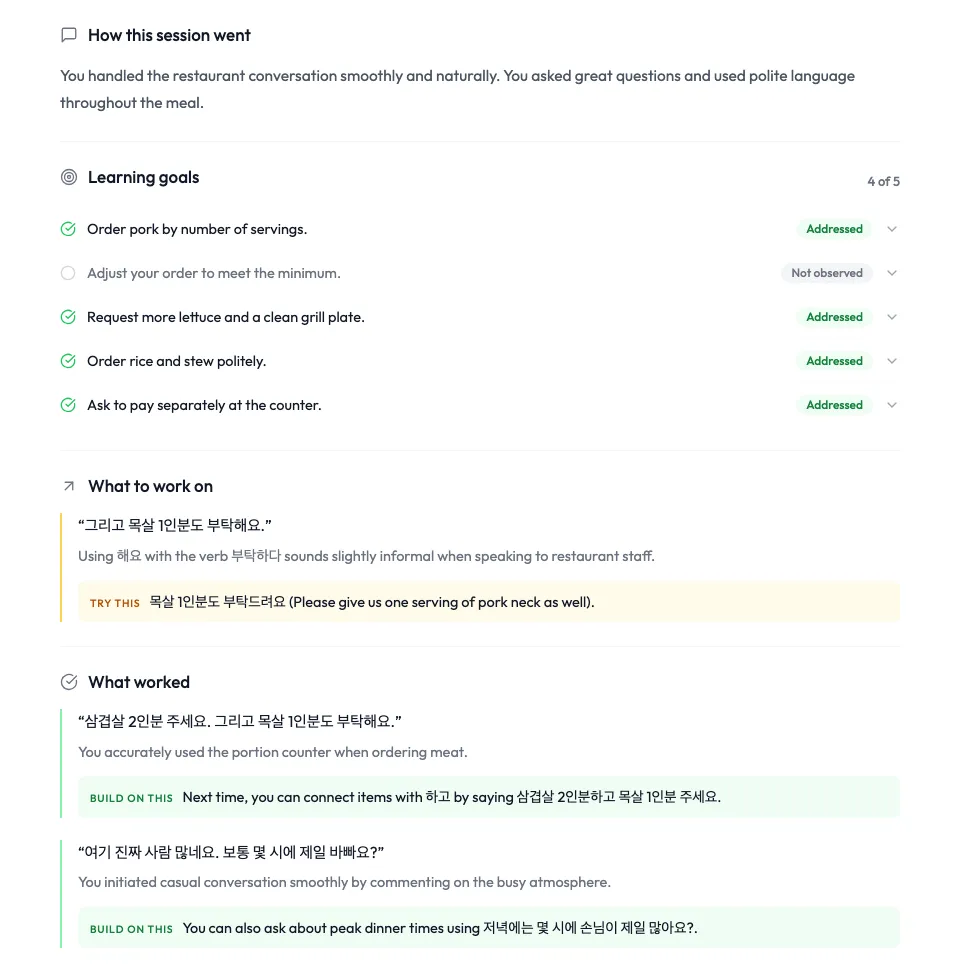
What the feedback pointed out
What the learner said
그리고 목살 1인분도 부탁해요.
A clearer way to say it
목살 1인분도 부탁드려요
Using the everyday polite ending with the verb for asking a favor sounds slightly informal when you're speaking to restaurant staff.
What the learner said
삼겹살 2인분 주세요. 그리고 목살 1인분도 부탁해요.
A clearer way to say it
삼겹살 2인분하고 목살 1인분 주세요.
You used the serving counter correctly when ordering the meat. Next time, you can join both items in one sentence with the word for "and."
What the learner said
아, 이제 계산할게요. 혹시 계산은 카운터에서 따로따로 할 수 있어요?
A clearer way to say it
따로 계산해도 될까요?
You asked clearly about how to pay before heading to the counter. You can also ask about splitting the bill this way.
How the meal usually goes
Who grills
At many places, especially pricier ones, staff grill the meat and cut it with scissors at your table. If they start, let them; 구워 드릴게요, guwo deurilgeyo, means they'll grill it for you. At cheaper or self-serve places, you grill it yourself.
The self-serve bar
A 셀프바, selpeuba, is a counter with lettuce, garlic, sauces and side dishes that you refill yourself, as often as you like. A sign reading 셀프, self-serve, near the water or side dishes means the same thing.
The rice or noodle course
Staff may ask 식사는 뭐로 하시겠어요?, Siksaneun mworo hasigesseoyo?. Here 식사, meal, means the rice or noodle course that rounds things off: rice, stew, cold noodles, or at some places fried rice made on the grill.
Paying and splitting the bill
Bills are paid at the counter by the door, not at the table, and there is no tipping. To split, you can say 따로 계산할게요, Ttaro gyesanhalgeyo, we'll pay separately. Many groups simply let one person pay at the counter and send their share by bank transfer later, which saves time when the counter is busy.
Drinking with people older than you
Barbecue usually comes with soju or beer, and when someone older or more senior is at the table, a few gestures matter more than words. How strictly people follow them varies by age, family and workplace; close friends of the same age are usually relaxed.
제가 한 잔 따라 드릴게요.
Reading: Jega han jan ttara deurilgeyo.
Meaning: Let me pour you a drink.
Say this to someone older as you pour. Hold the bottle with your right hand and support your right wrist or forearm with your left hand, or use both hands.
저는 조금만 주세요.
Reading: Jeoneun jogeumman juseyo.
Meaning: Just a little for me, please.
A polite way to accept a pour without drinking much. Leaving your glass partly full also signals that you don't need a refill yet.
The gestures that show respect
These matter most with elders, bosses and people you've just met. With close friends, people often drop them.
- Hold your glass with both hands when someone older pours for you.
- When you drink in front of someone older, turn your head slightly away and cover your mouth with your hand or glass.
- Don't pour your own drink. Watch for empty glasses around you and offer to refill them; someone will usually do the same for you.
- For the toast, people say 건배, geonbae, or the more casual 짠, jjan. When clinking with someone older, hold your glass a little lower than theirs.
Practice a barbecue order out loud
Restaurant talk is fast and noisy. If you rehearse the order, a refill and the question about splitting the bill, you'll recognize the replies when they come quickly.
- Open Create with AI and paste the description below. Change the cuts to the ones you like.
- Talk out loud with the AI owner. It answers by voice in Korean and can push back, for example with a two-serving minimum.
- After the conversation, read your feedback: the learning goals you covered, a clearer way to say one of your lines, and the full transcript. Ask the AI Coach anything about a suggestion.
- Try again, this time asking for a grill change and finishing with cold noodles.
Describe it like this when you create the activity
Korean, at a busy pork barbecue restaurant in Seoul. The AI plays the owner. I need to call them over, order meat by the serving, handle a two-serving minimum, ask for more lettuce and a clean grill plate, order rice and stew, and ask to pay separately at the counter. Beginner to intermediate level, polite speech.
Questions learners usually ask first
What does 인분, inbun, mean on a Korean menu?
It means one person's serving, so 2인분 is two servings. Barbecue meat is priced per serving, and the weight of one serving varies by restaurant; many menus print it next to the price. It's an amount of food, not a rule that each person must order one.
Can you eat Korean BBQ alone in Korea?
Yes, but not everywhere. Many barbecue places require two or more servings, at least on the first order, which is a lot for one person. Look for places that advertise solo dining, or ask at the door with 1인분도 주문돼요? before you sit down.
Should I call staff 저기요 or 사장님?
Either is fine. 저기요 works for anyone in any restaurant. 사장님 is warmer and very common at small, casual places, and many people use it even for staff who aren't the owner.
Do you tip at Korean BBQ restaurants?
No. Tipping isn't part of restaurant culture in Korea, and the price on the menu is what you pay. You pay at the counter on your way out, and a 잘 먹었습니다 to the staff as you leave is a nice touch.