
The rule that fixes most small talk: one detail, one question
When a coworker asks How was your weekend?, they don't want a report, and they don't want one word. A one-word answer like Good. can sound like you don't want to talk. A long story can leave them stuck. Aim for three short parts.
- A short answer: Pretty good, thanks!
- One detail: We finally tried that ramen place on Main Street.
- A question back: How about you? Do anything fun?
- If they share a detail back, react to it and ask one follow-up. Two or three turns each is a complete, successful conversation.
Six moments, six answers you can say
These are the moments when small talk usually happens in a US office or on a remote team. Each answer follows the one-detail pattern, so you can swap in your own detail.
Pretty good! I took my kids to a soccer tournament. How was yours?
Monday morning, when someone asks How was your weekend? If your weekend was quiet, Pretty quiet, which was nice. works just as well.
Morning! How's your week going so far?
Before a call, people also ask Where are you calling in from today? or comment on the weather. Keep it light, because others can join at any moment.
I really need this coffee today. How's your morning going?
Comments about what's in front of you are the easiest openers: the coffee, the weather, a busy week. Is this the new coffee machine? works too.
Have you been here before? What's good?
At a team lunch, food and restaurants are the safest topics. Follow up with Any other good places around here? or Do you cook much?
Well, that was a long one. Are you heading to lunch?
A small joke about a long meeting is usually fine. Criticizing a coworker who was in the room is not. That went well, I think. is a safe alternative.
Not much, just relaxing. Maybe a hike if the weather's nice. You?
On Friday afternoon, people ask Any plans for the weekend? A small plan is fine. To close the chat, say Have a good weekend!
Reactions that keep it going
When the other person shares a detail, a quick reaction shows you're listening. Then add one follow-up question, like Where did you go? or How was it?
Oh nice!
The most useful reaction of all. Say it warmly. A flat nice can sound bored.
No way! That's amazing.
Use it for bigger news: a new puppy, a marathon, concert tickets. For bad news, say Oh no, that's rough. instead.
That sounds fun! Who did you go with?
Works for past and future plans. If they didn't enjoy it, That sounds stressful. fits better.
Monday morning in the office kitchen
Monday, just after 9 a.m. You're getting coffee in the office kitchen when Dana, a coworker from another team, walks in.
Dana
Hey, good morning! How was your weekend?
You
Pretty good, thanks! My brother was in town, so we went to the farmers market. How about you?
Dana
Oh nice! We went camping at a lake up north.
You
Sorry, I missed that. You went where?
Dana
Camping! At a lake about two hours north of here.
You
That sounds fun! How was it?
Dana
Beautiful, but freezing at night. Anyway, I've got a call at nine-thirty.
You
Oh, I'll let you go. Good to see you!
The audio uses the AI voice you hear in ChitterChatter conversations.
When you miss something, and when it's time to go
Ending small talk is normal, and so is asking someone to repeat a word. Keep both short and friendly. Nobody expects a long goodbye.
Sorry, I missed that. What was the name of the place?
Asking about the exact part you missed shows you followed the rest. If you missed the whole sentence, a short Sorry, what was that? works.
Well, I'll let you get back to it.
Very common in US offices, especially when you stopped by someone's desk.
I've got a call in a few minutes, but it was good catching up!
You don't always need a reason. Anyway, good to see you! with a smile is enough.
Safe topics and risky ones in US offices
Small talk at work stays light because coworkers don't know each other's lives, and some questions can feel personal or judgmental. The lines shift by company, region and how close you are, but this is a good default with someone you don't know well.
- Usually safe: weekends, weather, food and restaurants, travel, sports, shows and movies, pets, hobbies, the commute, and light comments about the week.
- Easy questions that work with almost any coworker: How's your week going?, Watching anything good lately?, Any good lunch spots around here?.
- Usually avoided: someone's age, whether they're married or plan to have kids, salary or what things cost them, religion, politics, health, and weight or appearance.
- If a coworker mentions their own partner or kids, a friendly follow-up about what they shared is fine. Let them lead.
- If someone asks you something you'd rather not answer, keep it light and change the subject: Oh, I try to stay out of politics at work. How's your week going?
If small talk works differently where you're from
If you learned to talk at work in Japan
In many Japanese workplaces, frequent short responses while someone talks are polite, and a pause can feel comfortable. In US English, repeating yes can sound like you agree with everything, so mix in uh-huh, right or oh, really?. A few seconds of silence in US small talk often signals the chat is over, so ask your question back a little sooner than feels natural.
If you learned to talk at work in Vietnam
In Vietnamese, people often ask someone's age early, because age decides which words they use to address each other, and questions about marriage or family can be a friendly way to connect. In most US offices, coworkers don't ask about age or marriage unless the other person brings it up first. Start with weekends, food or travel instead.
If you learned to talk at work in India
Many workplaces in India use sir or ma'am for managers and senior colleagues. Most US offices use first names with everyone, including senior leaders, and sir can sound distant or overly formal. Listen to what others call them, or simply ask: Is it okay if I call you Mike?
If you learned to talk at work in the Philippines
In the Philippines, asking whether someone has eaten is a warm everyday greeting. In the US, Have you eaten? is usually taken literally and can sound like a lunch invitation. If you just want to say hi, How's your day going? does the job. Habits like these vary by family, region and company everywhere, so treat these notes as starting points.
From a real practice session
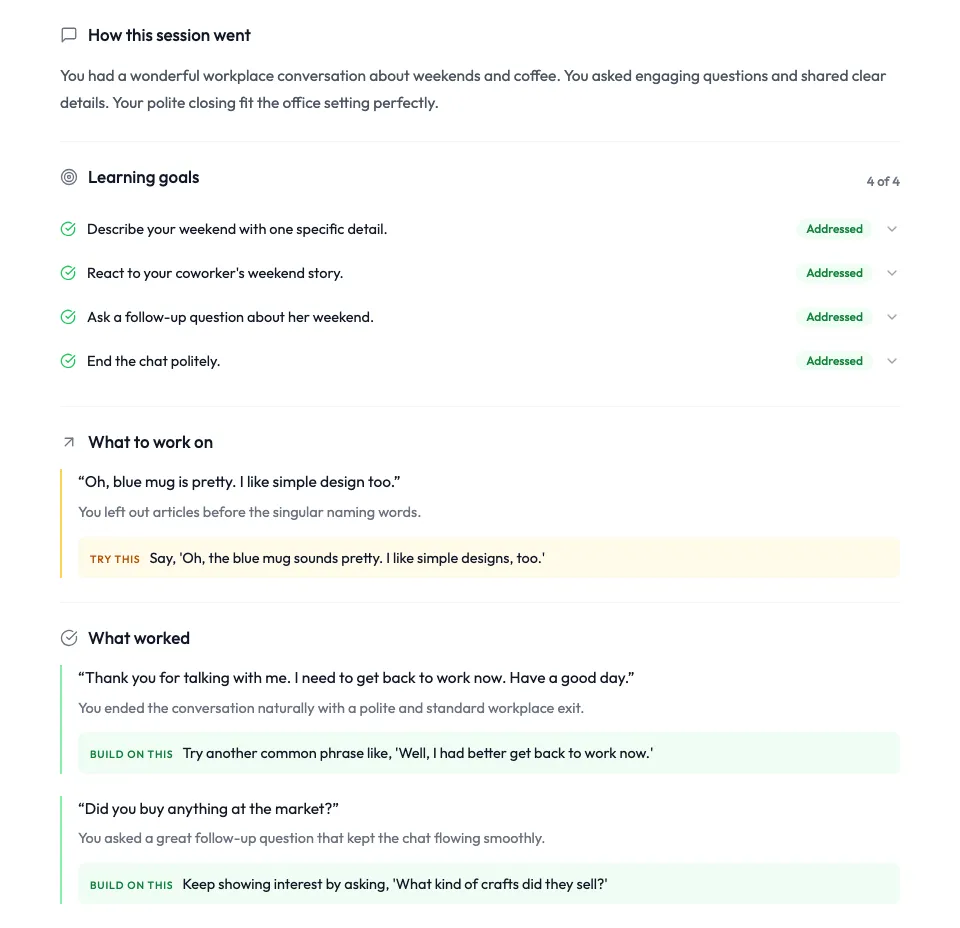
Our team ran this situation in ChitterChatter using the description in the practice section below. A synthetic voice spoke the learner's lines; the AI character's replies and the feedback are what ChitterChatter produced. Here are the first lines of the conversation, lightly trimmed.
Coworker
Good morning! How was your weekend?
You
Good morning! My weekend was nice, I went to a small park near my apartment. How about your weekend?
Coworker
I went to an outdoor craft market with my sister, but rain pushed us into a café for a bit. We found amazing lemon cake there.
You
That sound fun! Did you buy anything at the market?
Coworker
Yes, I picked up a handmade blue mug. It has a simple but lovely design.
You
Oh, blue mug is pretty. I like simple design too. Do you drink coffee every morning?
Coworker
I do, just one cup to start the day. What about you?
You
I drink coffee too, but sometimes I drink tea if I feel tired. Do you have a favorite kind of coffee?
Coworker
I usually stick with a medium roast, nothing fancy. How do you take yours?
You
I like coffee with a little milk, but sometimes I put sugar too. Do you ever try iced coffee?
Coworker
Sometimes in the summer, an iced coffee hits the spot. Do you like it that way?
What the feedback pointed out
What the learner said
Oh, blue mug is pretty. I like simple design too.
A clearer way to say it
Oh, the blue mug sounds pretty. I like simple designs, too.
You left out articles before singular nouns.
What the learner said
Did you buy anything at the market?
A clearer way to say it
What kind of crafts did they sell?
This was a great follow-up question that kept the chat flowing. Keep showing interest by asking more about what your coworker described.
What the learner said
Thank you for talking with me, I need to get back to work now. Have a good day!
A clearer way to say it
Well, I had better get back to work now.
This was a natural, polite and standard way to leave a chat at work. You can also try another common exit line like this one.
Practice small talk out loud
Small talk gets easier once the first few answers come out automatically. Rehearse these moments in a voice conversation until the one-detail pattern feels normal.
- Open Create with AI and paste the description below, or describe your own office and coworkers.
- Talk with the AI coworker out loud. Answer with one detail, ask a question back, and end the chat politely.
- Check the feedback: which learning goals you covered, a line you said with a clearer way to say it, and the full transcript.
- Ask the AI Coach about any suggestion, then run the conversation again with a different weekend story.
Describe it like this when you create the activity
English small talk in a US office on a Monday morning. The AI plays a friendly coworker from another team who asks about my weekend at the coffee machine and then talks about their own. I should answer with one detail, react to what they say, ask a follow-up question, and end the chat politely. Intermediate level.
Questions learners usually ask first
What are good small talk questions to ask coworkers?
Ask about things anyone can answer: their weekend, holiday plans, a good place for lunch nearby, a show they're watching, or how their week is going. Open questions work better than yes-or-no questions because they invite a detail. Then react to the answer and ask one follow-up.
How do I answer How was your weekend? if I didn't do anything?
Say it was quiet or relaxing, which most people hear as a good thing, then add one small detail: a meal you cooked, a walk, a show you watched, or catching up on sleep. Then ask about their weekend. Nobody expects an exciting answer every Monday.
How do I end a conversation with a coworker without being rude?
Give a short, friendly reason, like an upcoming call or getting back to work, and close with a warm line about it being good to chat. Ending small talk after a minute or two is completely normal in US offices, so there's no need to apologize.
Is it rude to skip small talk at work in the US?
Skipping it now and then is fine, especially when everyone is busy. Going straight to business every time can come across as cold, though, because small talk is how many US coworkers build trust before they need to work together. Even a quick greeting and one question at the start of a call helps.