Usted or tú: start formal, switch when they ask
With your partner's parents, grandparents, aunts and uncles, use usted (the formal you). It shows respect, and in Mexico it won't come across as cold. It is common for the parents to speak to you with tú right away while you keep using the formal form. That mismatch is normal: older people often use the informal form with younger people.
- The switch usually comes from them. Listen for háblame de tú or, from both parents at once, háblanos de tú. You will also hear tutéame, which means the same thing but is less common in Mexico. Thank them and switch from then on.
- Some people keep the formal form with in-laws for years, and in some families people use it even with their own parents and grandparents. If you are not sure, keep using it with grandparents.
- Your partner's siblings and cousins your age will expect tú from the first minute.
- When you talk to the whole family at once, use ustedes. Latin American Spanish uses it for any group, formal or not, so Gracias a todos and Me dio mucho gusto conocerlos work for everyone.
- One word changes with your own gender: men say encantado (delighted to meet you), women say encantada. When you mention your partner, say mi novio, mi novia, or the neutral mi pareja.
- Mexicans usually call parents mis papás. Your partner's parents become your suegros (in-laws) once you marry, and many people use the word for a long-term partner's parents too.
The first five minutes at the door
Say these to each person you meet, one at a time. Use the formal form with anyone older than your partner.
Buenas tardes, señora. Mucho gusto.
Meaning: Good afternoon, ma'am. Nice to meet you.
Use señor for a man. After dark, switch to Buenas noches, which works as both a greeting and a goodbye.
Gracias por recibirme en su casa.
Meaning: Thank you for having me in your home.
Polite and warm. Say it to the parents early, ideally while you hand over what you brought.
¿Cómo prefiere que le diga?
Meaning: What would you like me to call you?
In Mexico, decir is the everyday verb for what you call someone. Some parents want their first name, some prefer señora, and some like doña or don before their first name. Asking is respectful, and the answer saves you from guessing all night.
Customs that matter on the first visit
Greet every person, including the kids
In Mexico the usual greeting is a single light kiss on the right cheek between women, and between a man and a woman. Men usually shake hands, and may add a hug with a pat on the back once they know you. Some older relatives and some families prefer a handshake from a guest they just met. Let the other person lead: if they lean in, lean in; if they put out a hand, shake it. Go around the room, grandparents first if they are there, and greet the kids too.
Bring something for the table
A dessert, a box of pan dulce (sweet bread) from a good bakery, or flowers for the parents are safe choices. Ask your partner before bringing alcohol, since some families don't drink. Hand it to the parent who is hosting with Les traje un postre (I brought you a dessert).
The big meal is often in the afternoon
In many Mexican homes the main family meal, la comida, happens in the afternoon, often around two to four, and the evening meal is lighter. So your first dinner may really be a long Sunday lunch. After eating, people stay at the table talking, the sobremesa. Getting up right after your plate is empty can look rushed, so stay and talk.
The goodbye takes a while
Saying you're leaving starts the goodbye; it doesn't end the visit. Expect another round of conversation, then say goodbye to each person individually with the same kiss or handshake you used when you arrived. A single wave to the whole room as you walk out is easy to notice.
Sunday lunch at your partner's parents' house
Sunday afternoon in Guadalajara. Your partner's mother opens the door; later their father joins you at the table.
Mother
¡Hola! Pásale, pásale. Estás en tu casa.
Meaning: Hi! Come in, come in. Make yourself at home.
You
Buenas tardes, señora. Mucho gusto. Gracias por recibirme.
Meaning: Good afternoon, ma'am. Nice to meet you. Thank you for having me.
Mother
Ay, el gusto es mío. Ya nos habían platicado mucho de ti.
Meaning: Oh, the pleasure is mine. We've already heard a lot about you.
You
Les traje un postre para después de la comida.
Meaning: I brought you a dessert for after the meal.
Father
Qué amable. Siéntate, siéntate. ¿Qué te sirvo de tomar?
Meaning: How kind. Sit down, sit down. What can I get you to drink?
You
Lo que tengan está bien, gracias.
Meaning: Whatever you have is fine, thank you.
Mother
¿Te sirvo más mole?
Meaning: Can I give you some more mole?
You
Sí, gracias, nomás un poquito. Le quedó riquísimo, señora.
Meaning: Yes, thanks, just a little. It turned out delicious, ma'am.
Father
Oye, y háblanos de tú, ¿eh? Nos haces sentir viejos.
Meaning: Hey, and talk to us informally, okay? You're making us feel old.
You
Está bien, gracias. Me va a costar trabajo, pero lo intento.
Meaning: Okay, thank you. It's going to be hard for me, but I'll try.
The audio uses the AI voice you hear in ChitterChatter conversations.
At the table
Praise the food to the person who cooked it, not just to the room. If you switched to tú, change le to te in the first phrase.
¡Le quedó riquísimo!
Meaning: It turned out delicious!
Very Mexican and very warm: it praises the cook, not just the dish. With the informal form it becomes ¡Te quedó riquísimo!.
Sí, gracias, nomás un poquito.
Meaning: Yes, thank you, just a little.
Accepting seconds is a compliment. Nomás (just) is everyday Mexican Spanish; elsewhere you'll hear solo un poquito.
Ya no puedo más, gracias. Todo estuvo buenísimo.
Meaning: I can't eat any more, thank you. Everything was wonderful.
How to turn down a third helping without sounding like you didn't like it. Expect to be offered more at least once after you say it.
Provecho.
Meaning: Enjoy your meal.
Said when you walk past people who are eating, when you sit down, and when you get up from the table while others are still eating. The usual answer is Gracias.
Con permiso.
Meaning: Excuse me (with your permission).
Use it to leave the table, go to the bathroom, or walk past someone. In Mexico people often answer Propio or Pásale, both meaning go ahead.
¿Le ayudo con los platos?
Meaning: Can I help you with the dishes?
Offer once when the table is being cleared. Many hosts will say no and tell you to sit; offering still counts.
The questions you'll almost certainly get
Families ask the same few things at a first meal. Prepare one sentence and one detail for each, then ask something back so it feels like a conversation, not an interview.
- ¿Y a qué te dedicas? What do you do for work? Answer with your job and one detail: Soy maestra de primaria en Houston. (I'm an elementary school teacher in Houston; a man says maestro).
- ¿Cómo se conocieron? How did you two meet? Start with Nos conocimos en... (we met at...), then let your partner add the story.
- ¿Y tu familia? ¿De dónde son? And your family? Where are they from? Mention your parents and siblings, then ask ¿Y ustedes siempre han vivido aquí? (Have you always lived here?).
- ¿Dónde aprendiste español? Where did you learn Spanish? A friendly answer: Estoy aprendiendo para poder platicar con ustedes. (I'm learning so I can talk with you.)
- ¿Sí le entras al chile? Do you eat spicy food? This one is often half a joke. Sí, pero poquito (yes, but just a little) always gets a smile.
From a real practice session
Our team ran this situation in ChitterChatter using the description in the practice section below. A synthetic voice spoke the learner's lines; the AI character's replies and the feedback are what ChitterChatter produced. Here are the first lines of the conversation, lightly trimmed.
Mother
¡Hola, qué gusto conocerte! Pasa, por favor. ¿Cómo estás?
Meaning: Hi, so nice to meet you! Come in, please. How are you?
You
Hola, señora. Muchas gracias por invitarme. Estoy un poco nervioso, pero muy contento de estar aquí.
Meaning: Hello, ma'am. Thank you so much for inviting me. I'm a little nervous, but very happy to be here.
Mother
Bienvenido, aquí estamos en confianza, siéntete cómodo. Cuéntame, ¿cómo ha estado tu semana?
Meaning: Welcome. You're among family here, so make yourself comfortable. Tell me, how has your week been?
You
Muchas gracias. Mi semana estuvo bien, trabajé mucho en la oficina y estudié español para poder hablar mejor con ustedes hoy. ¿Y usted cómo estuvo su semana?
Meaning: Thank you very much. My week was good. I worked a lot at the office and studied Spanish so I could talk with all of you better today. And how was your week?
Mother
Qué dedicado, me da gusto. Fue tranquila, estuve probando esta receta de pozole. ¿Te gusta cómo quedó?
Meaning: How dedicated, I'm glad. It was quiet. I've been trying out this pozole recipe. Do you like how it turned out?
You
Sí, me gustó mucho, señora. El pozole tiene un sabor muy rico y el maíz está perfecto. Nunca había probado algo así en mi país.
Meaning: Yes, I really liked it, ma'am. The pozole has a delicious flavor and the corn is perfect. I'd never tried anything like it in my country.
Mother
Me alegra que te guste. Háblame de tú, por favor. ¿Qué sueles comer en casa que te hace sentir bien?
Meaning: I'm glad you like it. Please use the informal you with me. What do you usually eat at home that makes you feel good?
You
¡Gracias! Ok, te hablo de tú. Pues, cuando estoy en casa, me gusta comer pasta o pollo con verduras. No sé cocinar tan bien como tú, pero intento hacer algo saludable. ¿Tienes una comida favorita de aquí de Guadalajara?
Meaning: Thanks! Okay, I'll use the informal you. Well, at home I like to eat pasta or chicken with vegetables. I can't cook as well as you, but I try to make something healthy. Do you have a favorite food from here in Guadalajara?
Mother
Mmm, me encanta la birria, sobre todo con tortillas calientitas. ¿Tú has probado la birria aquí?
Meaning: Mmm, I love birria, especially with nice warm tortillas. Have you tried birria here?
You
Sí, probé birria una vez con tu hijo, en un mercado. Era muy picosa para mí, pero tenía mucho sabor. Creo que necesito practicar comer más chile, ¿no?
Meaning: Yes, I had birria once with your son, at a market. It was really spicy for me, but it had a lot of flavor. I think I need to practice eating more chili, right?
Mother
Jajaja, poco a poco, no hay prisa. ¿Prefieres algo más suave o te animas a probar más chile hoy?
Meaning: Ha ha, little by little, there's no rush. Would you rather have something milder, or are you up for trying more chili today?
What the feedback pointed out
What the learner said
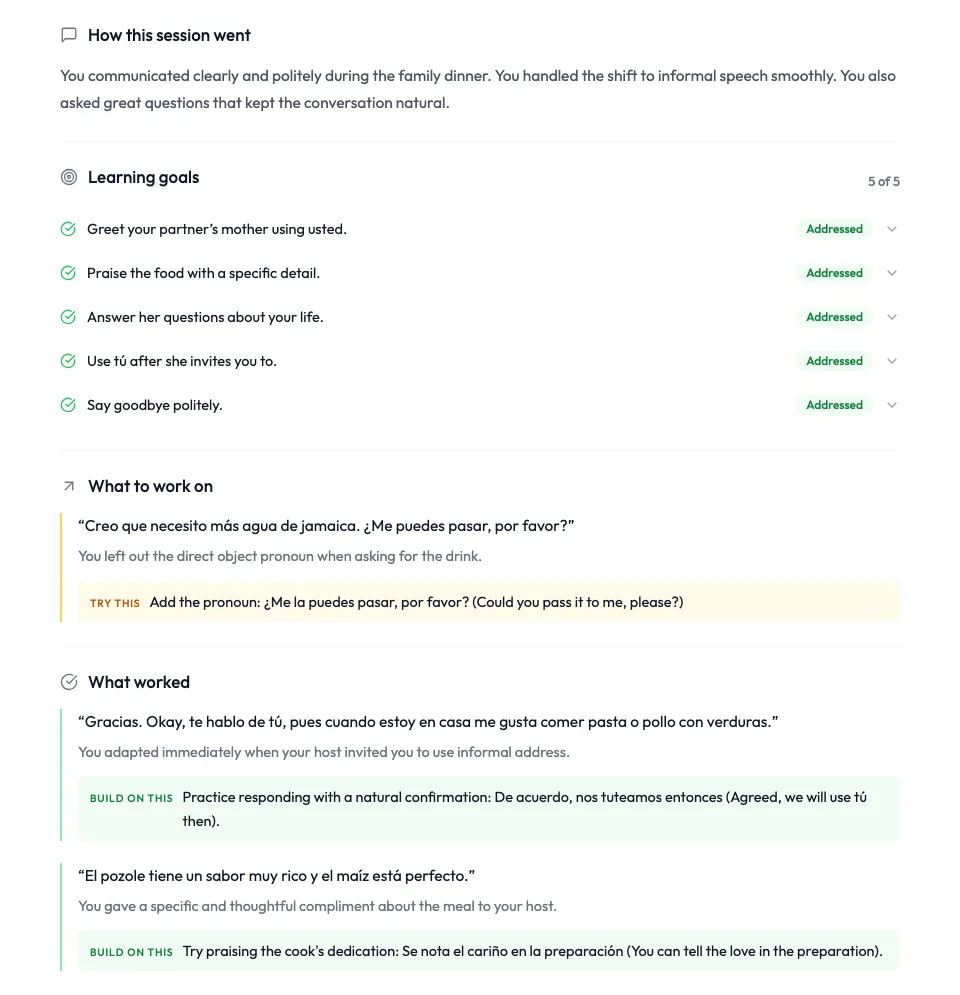
Creo que necesito más agua de jamaica, ¿me puedes pasar, por favor?
A clearer way to say it
¿Me la puedes pasar, por favor?
When you asked for the drink, you left out the direct object pronoun. Add it to ask "Could you pass it to me, please?"
What the learner said
¡Gracias! Ok, te hablo de tú.
A clearer way to say it
De acuerdo, nos tuteamos entonces.
You switched to the informal you right away when your host invited you to. To build on it, practice a natural way to confirm the switch, like saying "Agreed, we'll use the informal you then."
What the learner said
El pozole tiene un sabor muy rico y el maíz está perfecto.
A clearer way to say it
Se nota el cariño en la preparación.
Your compliment on the meal was specific and thoughtful. To build on it, also praise the care the cook put in, saying you can tell the love that went into making it.
When you're lost, and when it's time to go
Saying you're still learning is fine. Families are usually delighted you're trying.
Perdón, ¿me lo puede repetir un poquito más despacio?
Meaning: Sorry, could you say that again a little more slowly?
Your repair phrase. Use it as often as you need; it is much better than nodding along.
Muchas gracias por todo. Me dio mucho gusto conocerlos.
Meaning: Thank you so much for everything. It was really nice to meet you all.
Say it to the parents at the door, then give each person their own goodbye.
Que descansen.
Meaning: Have a good rest. (Good night.)
A common way to say goodbye in the evening in Mexico, said to the whole family as you leave.
If your partner's family isn't Mexican
Spain
Two kisses, one on each cheek, between women and between a man and a woman; men usually shake hands. Many parents use tú both ways from the first meeting, so the formal form can sound stiffer there. Follow their lead.
Colombia and Costa Rica
In many regions people use usted even with close friends and family, so it will feel natural for the whole visit, and you may hear it used with you too.
Argentina and Uruguay
The informal you is vos instead of tú, so the invitation sounds like tratame de vos. A single cheek kiss is common, and in Argentina it is often used between men who know each other too.
Rehearse the meal before it happens
The hard part is answering questions while you're also being polite and eating. Run the conversation out loud a few times so the greeting, the compliments and your answers about yourself come out without thinking.
- Open Create with AI and paste the description below, changing the city, who you're meeting, and your level.
- Talk through the visit out loud: greet, answer the family's questions, praise the food, and say goodbye.
- Read your feedback: which goals you covered, a line you said with a clearer way to say it, and the full transcript. Ask the AI Coach about any suggestion you're unsure of.
- Repeat the conversation and try to switch smoothly once the parent invites you to.
Describe it like this when you create the activity
Practice Mexican Spanish: I'm meeting my partner's parents for the first time at a Sunday family meal at their home in Guadalajara. The AI plays my partner's mother, who welcomes me, offers food, asks what I do and how we met, and later invites me to stop using the formal you. I should greet her formally, praise the food, answer her questions, and say goodbye politely. Level: intermediate (B1).
Questions learners usually ask first
Should I use usted or tú with my girlfriend's or boyfriend's parents?
Start with the formal form, even if they use the informal one with you. In Mexico it is normal for parents to speak informally to a younger guest while the guest stays formal. Switch when they invite you to, and thank them when they do.
What do you say when you meet your partner's parents in Spanish?
Greet each parent separately with good afternoon or good evening, ma'am or sir, and nice to meet you, using the formal you. Thank them for having you in their home and ask what they would like you to call them. At the table, praise the food to whoever cooked it, and before you leave, thank them and say goodbye to each person.
Do you kiss on the cheek when meeting a Mexican family?
Often, yes. A single light kiss on the right cheek is common between women and between a man and a woman, while men usually shake hands. Some families and older relatives prefer a handshake with a new guest, so let each person lead and greet everyone individually.
What should I bring when meeting my partner's parents in Mexico?
A dessert, sweet bread from a bakery, or flowers are safe and appreciated. Ask your partner before bringing alcohol, and hand your gift to the parent who is hosting when you arrive.