
The level is a ceiling, not a target
Where to find this: Activities › open an activity › Objectives › Target proficiency level
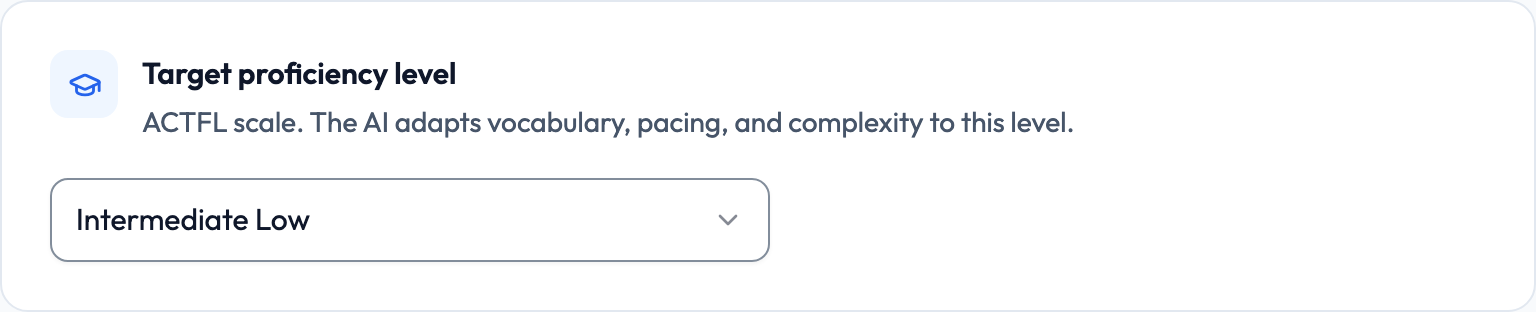
On the Objectives step you set a Target proficiency level on the ACTFL scale. It's worth knowing exactly how this is used, because it isn't what most people assume. The AI is told that the level is a ceiling rather than a target, and instructed that when in doubt it should simplify.

Lemon says: Setting a higher level doesn't make the AI give speeches. It makes it talk richer.
Each level keeps the AI's turns short
Behind the scenes, every ACTFL level limits how long the AI's turns can be. Lower levels get the shortest turns, and the limit grows gently with the level. This is what stops the AI from lecturing at your students, and it's why even an Advanced activity keeps the student doing most of the talking.
Lemon says: The limit stops growing at Advanced. Past that point, richness comes from vocabulary and structure, not length.
Picking the right level for a mixed class
Real sections are never uniform. Because the level acts as a ceiling and the AI is told to simplify when uncertain, aiming slightly below your median student is usually the better error. A student who finds it easy will still practice; a student who is lost will disengage entirely.
- Aim at roughly the 40th percentile of your section, not the median
- Novice Mid is a safer first-activity choice than Novice High for a true beginner course
- If you're between two sublevels, take the lower one for the first activity and raise it later
Lemon says: The frustrated-beginner problem is real and it's the fastest way to lose a student. When in doubt, go one notch down.
Adding context the level alone can't capture
Below the level picker is an Additional Proficiency Context box. This is where you describe the ways your specific group doesn't fit the standard profile — and that text is passed to the AI as instructor notes about the group's level.
A heritage-speaker section
Strong listening comprehension and near-native pronunciation, but limited formal register and little experience with written-register vocabulary. Don't slow down for comprehension — do explain formal vocabulary when it comes up.
A reading-heavy programme
Strong reading comprehension and a broad passive vocabulary, but very limited spoken production. Students will understand more than they can say. Give extra wait time and don't assume that comprehension means they can produce the same forms.
Lemon says: This box is where you tell the AI about the gap between what your students can read and what they can say.
Level, pace, and support work together
The proficiency level, the speaking pace on the Scenario step, and the scaffolding settings all affect difficulty. Changing one in isolation often doesn't achieve what you wanted. Think of them as one combined difficulty dial.
"My students say it's too hard"
Drop the level one sublevel, set pace to 0.85×, and set stuck-learner support to "Offer a phrase to use". Changing only the level rarely fixes it on its own.
"My students say it's too easy"
Raise the level one sublevel, set pace to 1.10×, and make sure the other-language setting is "Understands, but only speaks the target language". Then add a complication to the scenario so there's more to negotiate.
Lemon says: Try the activity yourself after adjusting. Two minutes of listening tells you more than any amount of reasoning about settings.