
The most common complaint: it runs out
The single most frequent problem instructors report is a scenario that's exhausted long before the minimum time. The student orders a coffee, the AI says thank you, and there are six minutes left with nothing to do. This is almost never an AI problem — it's a scenario design problem, and it's fixable.

Lemon says: A transaction ends. A situation continues. That's the whole difference.
The four ingredients
Scenarios that sustain a real conversation almost always have the same four ingredients. You can check any scenario against this list in about thirty seconds.
- A setting — where this is, concretely enough to picture
- A relationship — who these two people are to each other
- A goal — what the student is trying to accomplish
- A complication — the reason it isn't straightforward
Lemon says: Most weak scenarios have the first three. It's almost always the complication that's missing.
The complication is the engine
A complication is anything that stops the student's goal from being achieved in one exchange. It doesn't need to be dramatic — a small obstacle generates several turns of genuine negotiation, which is exactly what you want them practicing.
Without a complication
The student orders a meal at a restaurant. You are the server.
Realistic run time: about ninety seconds. Order, confirm, done.
With a complication
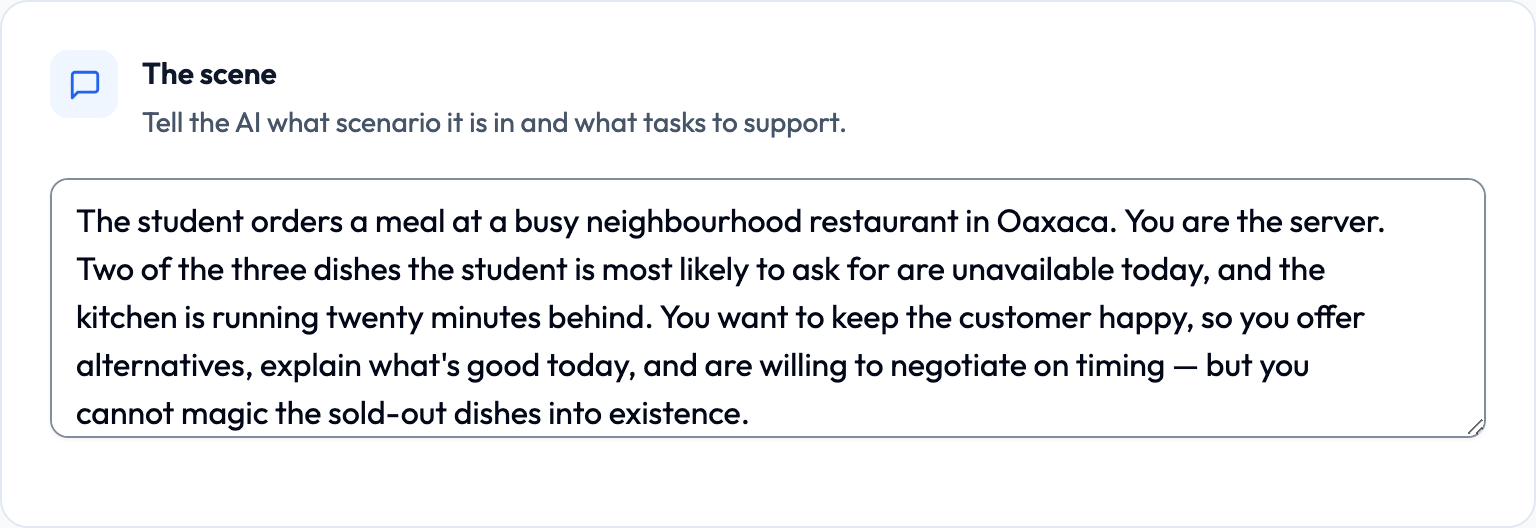
The student orders a meal at a restaurant. You are the server. Two of the three dishes the student is most likely to ask for are unavailable today, and the kitchen is running twenty minutes behind. You want to keep the customer happy, so you offer alternatives, explain what's good today, and are willing to negotiate on timing — but you cannot magic the sold-out dishes into existence.
Now the student has to ask questions, understand alternatives, express a preference, and negotiate. That's five to eight minutes of real language use.
Lemon says: 'Sold out', 'running late', 'wrong size', 'we only take cash' — small obstacles, lots of language.
A menu of complications
You don't have to invent these from nothing. Most useful complications fall into a handful of patterns that transfer across almost any setting.
- Scarcity — the thing they want isn't available, so alternatives must be discussed
- Constraint — a budget, a deadline, a dietary restriction, a size that doesn't exist
- Ambiguity — the character needs more information before they can help
- Mild resistance — the character has a different preference and will say so once
- A second task — something else comes up that also needs handling
- Curiosity — the character is genuinely interested and asks the student about themselves
Lemon says: Curiosity is the cheapest one and it works everywhere. A character who asks questions back doubles your speaking time.
Give the character something to want
A complication gives the student something to do. A character goal gives the AI something to do — which matters enormously when the student goes quiet. A character with their own agenda will fill a silence in a natural, in-character way instead of asking "is there anything else I can help you with?" for the fourth time. (The AI only speaks into an actual silence if you turn on Follow up after silence on the Scenario step.)
Character with an agenda
You're proud of the seasonal dish and want at least one table today to try it. You're also mildly curious about the customer — this isn't a neighbourhood you see many visitors in, and you'll ask where they're from if there's a natural opening.
Two engines: something to sell, and something to be curious about. The AI now has moves available whenever the conversation stalls.
Lemon says: This is the fix for 'the AI keeps asking the same question'. It repeats because it has nothing else it wants.
Match the scope to the clock
Scope the scenario to the session length you set on Basic Info. A rough guide: one topic sustains about two minutes of genuine exchange at Intermediate level, and rather less at Novice, where turns are shorter and pauses longer.
- 3-minute session — one goal, one small complication
- 5-minute session — one goal, one complication, and a character who asks the student something
- 8–10-minute session — two connected goals, or one goal that develops in stages
Lemon says: If you set a ten-minute minimum, sketch out what happens in minutes six through ten before you assign it.
A full worked example
Here's the same activity at three levels of quality, so you can see what the difference actually looks like in the field.
Version 1 — thin
The student is at a pharmacy buying medicine.
No relationship, no goal beyond 'buy', no complication. Will run dry immediately.
Version 2 — better
The student is at a neighbourhood pharmacy. They have a cold and need something for it. You are the pharmacist. Ask about their symptoms before recommending anything.
Now there's a reason to talk — describing symptoms. Still likely to finish in three minutes.
Version 3 — sustains a full session
The student comes into a neighbourhood pharmacy with cold symptoms. You are the pharmacist on duty. Before recommending anything you need to know what their symptoms are, how long they've had them, and whether they're taking anything else. The strongest option you carry needs a prescription, so you'll have to explain what you can offer over the counter and what it does. You also think they should see a doctor if it hasn't improved in three days, and you'll say so. If they seem unsure about dosage, walk them through it clearly.
Goal (get relief), complication (the best option needs a prescription), character agenda (recommend seeing a doctor), and a built-in second task (explaining dosage). Comfortably fills eight minutes.
Lemon says: Version 3 took maybe four extra minutes to write. It's the difference between an activity students finish and one they abandon.
A checklist before you finish
Run through these five questions. If you can answer all of them from what you've written, the scenario will hold up.
- Can I picture the physical setting?
- Do I know what the student is trying to achieve?
- Is there a reason it takes more than one exchange?
- Does the character want something of their own?
- If the student went silent for ten seconds, would the character have something natural to say?
Lemon says: That last one is the real test. If you can't answer it, neither can the AI.