
What the Cultural Context field actually does
Where to find this: Activities › open an activity › Scenario › Cultural context
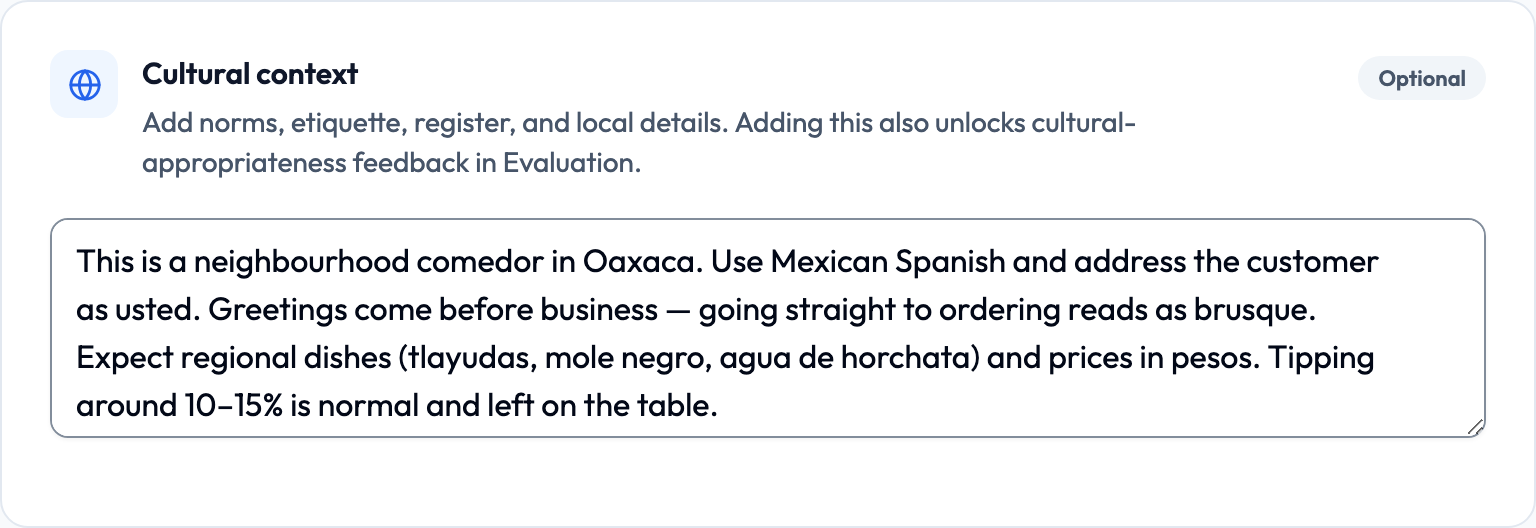
Cultural Context is an optional field on the Scenario step, but it does more work than its placement suggests. When you fill it in, it becomes its own section in the AI's instructions, which tells the AI this background is part of who its character is, to be held in how it speaks on every turn. It is not decorative background; it directly shapes how the AI talks.

Lemon says: Leave it empty and you get 'textbook nowhere'. Fill it in and you get a place.
Name the place, not the continent
The single most common mistake here is writing at country or continent scale. "Latin American culture" or "Chinese culture" covers so much variation that the AI has nothing concrete to work with. Narrow it to a city, a region, or an institution.
Too broad
Spanish-speaking culture. Be culturally appropriate.
This gives the AI no dialect, no norms, and no specifics. It will produce a neutral pan-Hispanic register that belongs nowhere.
Specific enough to be useful
This is a neighbourhood café in Buenos Aires. Use rioplatense Spanish: voseo (vos tenés, vos querés) rather than tú, and Argentine vocabulary — medialunas rather than croissants, un cortado, la cuenta. Greetings are warm and physical; small talk before business is expected, and going straight to ordering reads as brusque. Lunch runs late by North American standards.
Dialect, vocabulary, and interaction norms — the three things that actually change the AI's output.
Lemon says: City-level beats country-level. Country-level beats nothing. But city-level is where it starts sounding real.
The three things worth specifying
You don't need an ethnography. Almost all of the value comes from three categories, and you can usually cover them in four or five sentences.
- Variety and dialect — which regional variety, and any distinctive grammar (voseo, vosotros, Quebec French, Egyptian vs. MSA Arabic)
- Vocabulary that differs by region — the words for everyday objects, food, transport, and money that shift across borders
- Interaction norms — greeting rituals, how much small talk precedes business, directness, physical distance, tipping, punctuality, forms of address
Lemon says: Interaction norms are the ones students never get from a textbook, and the ones that make a conversation feel foreign in a useful way.
Worked examples across languages
Here are four cultural contexts written at roughly the right level of detail. Notice that each one names a place, names specific language features, and names at least one social expectation.
French — Quebec
A hardware store in Quebec City. Use Quebec French: tutoiement is normal between adults of similar age in a shop, and expect regional vocabulary (magasiner, char for car, dépanneur). Service is friendly and direct without extended small talk. Prices are in Canadian dollars and taxes are added at the register, not shown on the shelf.
Japanese — Osaka
A small okonomiyaki restaurant in Osaka. The owner speaks Kansai-ben with customers (ええ instead of いい, おおきに for thanks) but keeps です/ます politeness with someone new. Ordering is casual and the owner will happily recommend. Tipping does not exist and offering it causes confusion.
Arabic — Cairo
A pharmacy in downtown Cairo. Use Egyptian Colloquial Arabic, not Modern Standard. Greetings are extended and reciprocal — expect several exchanges before business begins. Address a customer with حضرتك for politeness. Bargaining is not appropriate in a pharmacy, though it would be in a market.
German — Vienna
A traditional coffee house in Vienna. Use Austrian German: Jänner not Januar, Sackerl not Tüte, and Grüß Gott as the standard greeting. The waiter is formally polite, uses Sie throughout, and is comfortable with silence — lingering over one coffee for an hour is entirely normal and should not be rushed.
Lemon says: Steal these shapes. Swap the place and the details and you've got a working cultural context in two minutes.
Matching the region to your students
If your programme teaches a particular variety, say so explicitly — otherwise the AI will drift toward whichever variety is most represented in its training data, which is usually the one with the largest online presence. That may be exactly the variety your students aren't learning.
- Spanish programmes teaching peninsular Spanish should name vosotros explicitly, or the AI will default to ustedes
- Portuguese programmes should state Brazilian or European — they diverge sharply in pronunciation and address
- Chinese programmes should state simplified or traditional characters, and mainland or Taiwanese usage
- Arabic programmes should state the dialect, since MSA is rarely what a conversation actually sounds like
Lemon says: If you've ever had a student come back using a form your textbook doesn't teach, this field is the fix.
Culture as content, not just decoration
The most interesting use of this field is to make a cultural norm the thing being practiced, rather than the backdrop. Set up a situation where getting the culture wrong has a visible consequence in the conversation — the character reacts, and the student notices.
Norm as the lesson
You are a host welcoming a guest into your home in Seoul. You expect the guest to remove their shoes at the entrance and to accept tea when it is offered — declining outright is awkward. If the guest declines, don't lecture them; simply offer once more, a little more warmly, the way a real host would.
The student gets feedback from inside the roleplay rather than from a rubric afterwards, which is far more memorable.
Lemon says: The best cultural moments are the ones where the character reacts, not where a grade explains what went wrong.