The bonjour rule
In a French shop, Bonjour is not small talk, it's the price of entry. Starting with your order, even with a polite please, sounds abrupt and can get you a noticeably cooler welcome. Say it when it's your turn, look at the person, and only then order.
- Adding madame or monsieur is a little warmer and very common. Don't add a last name, and don't use mademoiselle; it is now widely avoided, and official forms dropped it in 2012.
- From early evening (there's no fixed hour, but often from around six), switch to Bonsoir. If you're unsure, the person serving you will often say it first; just repeat it.
- Leave with Merci, bonne journée, or in the afternoon bonne fin de journée, and in the evening bonne soirée. If they wish you one first, answer Merci, vous aussi.
What to say when it's your turn
The textbook Je voudrais... (I would like) is always fine. In shops, many people say it the way the last phrase here does.
Bonjour, madame.
Meaning: Hello, ma'am.
Or Bonjour, monsieur. Said to the person serving you, before anything else.
Une tradition pas trop cuite, s'il vous plaît.
Meaning: A tradition baguette, not too well baked, please.
Swap in bien cuite for a darker, crunchier loaf. Regulars often shorten the name to une tradi.
Une demi-baguette, s'il vous plaît.
Meaning: Half a baguette, please.
Many bakeries sell halves, but not all. If you're not sure, ask Vous faites les demi-baguettes ? (Do you sell half baguettes?).
Je vais vous prendre deux pains au chocolat.
Meaning: I'll take two chocolate croissants.
Casual but polite, and extremely common in shops. It sounds more natural in a fast line than a full textbook sentence.
Tradition, demi, and how well baked
The bread words are where learners hesitate, so decide before you reach the counter.
- Une tradition is short for the traditional French baguette. Since a 1993 decree, a loaf sold under that name must be made from wheat flour, water, salt, and yeast or sourdough (plus tiny amounts of a few approved flours), with no additives, and the dough can never be frozen. It usually costs a little more than a regular baguette and has a chewier crumb and a crust with more flavor.
- Une baguette on its own gets you the regular one, sometimes labeled classique or ordinaire. Some bakeries also sell a thinner ficelle.
- Bien cuite means well baked, darker and crunchier. Pas trop cuite means lighter and softer. People really do have strong preferences, and the clerk will pick from the rack to match.
- Point and use the right word for the item: celui-là (that one) for masculine items like a croissant or an éclair, celle-là for feminine ones like a baguette or a tart. If you don't know the name, Comment ça s'appelle, ça ? (What's that called?) works, though in a long line pointing is faster.
What the person behind the counter says
These come fast. Recognizing them is half the job.
C'est à qui ?
Meaning: Whose turn is it?
Answer C'est à moi (it's my turn). You may also hear Je vous écoute, literally I'm listening to you, which means go ahead.
Qu'est-ce qu'il vous fallait ?
Meaning: What can I get you?
Literally what did you need, in the past tense. It's a polite shop habit, not a question about the past, and you answer with your order.
Et avec ceci ?
Meaning: Anything else?
Literally and with this. Add the next item, or say you're done. A close cousin is Ce sera tout ? (Will that be all?).
Vous avez la monnaie ?
Meaning: Do you have coins, or anything smaller?
Asked when you hand over a big note for a small total. You may also hear Vous n'avez pas plus petit ? (Nothing smaller?). It's a request, not a complaint.
Saturday morning at a Paris boulangerie
A neighborhood bakery in Paris on a Saturday morning. There are four people in line behind you.
Baker
Bonjour ! C'est à qui ?
Meaning: Hello! Who's next?
You
Bonjour ! C'est à moi. Une tradition pas trop cuite, s'il vous plaît.
Meaning: Hello! It's my turn. A tradition baguette, not too well baked, please.
Baker
Celle-là, ça vous va ? Et avec ceci ?
Meaning: This one, is that okay? Anything else?
You
Parfait. Et deux croissants, s'il vous plaît.
Meaning: Perfect. And two croissants, please.
Baker
Ce sera tout ?
Meaning: Will that be all?
You
Oui, c'est tout pour moi.
Meaning: Yes, that's all for me.
Baker
Alors, ça fera trois euros quatre-vingts, s'il vous plaît.
Meaning: So, that'll be three euros eighty, please.
You
Je peux payer par carte ?
Meaning: Can I pay by card?
Baker
Bien sûr, allez-y, sans contact. Merci, bonne journée !
Meaning: Of course, go ahead, contactless. Thank you, have a good day!
You
Merci, vous aussi. Au revoir !
Meaning: Thanks, you too. Goodbye!
The audio uses the AI voice you hear in ChitterChatter conversations.
From a real practice session
Our team ran this situation in ChitterChatter using the description in the practice section below. A synthetic voice spoke the learner's lines; the AI character's replies and the feedback are what ChitterChatter produced. Here are the first lines of the conversation, lightly trimmed.
You
Bonjour monsieur !
Meaning: Hello, sir!
Baker
Bonjour, monsieur. C'est à qui ?
Meaning: Hello, sir. Who's next?
You
C'est à moi, je voudrais une baguette tradition pas trop cuite et deux croissants, s'il vous plaît.
Meaning: It's my turn. I'd like a tradition baguette, not too well baked, and two croissants, please.
Baker
Très bien, une tradition pas trop cuite et deux croissants. Et avec ça ?
Meaning: Very good, a tradition baguette not too well baked and two croissants. Anything else?
You
Non, c'est tout, merci.
Meaning: No, that's all, thanks.
Baker
D'accord, ça fait quatre euros.
Meaning: Okay, that comes to four euros.
You
Je paye avec un billet de vingt euros.
Meaning: I'm paying with a twenty-euro bill.
Baker
Vous avez de la monnaie ?
Meaning: Do you have any coins?
You
Euh… non, j'ai pas de monnaie, désolé.
Meaning: Um... no, I don't have any coins, sorry.
Baker
Pas de problème, je vous rends seize euros. Voilà, merci, bonne journée !
Meaning: No problem, here's sixteen euros back. There you go, thank you, have a good day!
You
Merci beaucoup ! Il fait beau aujourd'hui, non ?
Meaning: Thanks a lot! Nice weather today, isn't it?
Baker
Oui, il y a du soleil. Ça fait du bien.
Meaning: Yes, it's sunny. It feels good.
What the feedback pointed out
What the learner said
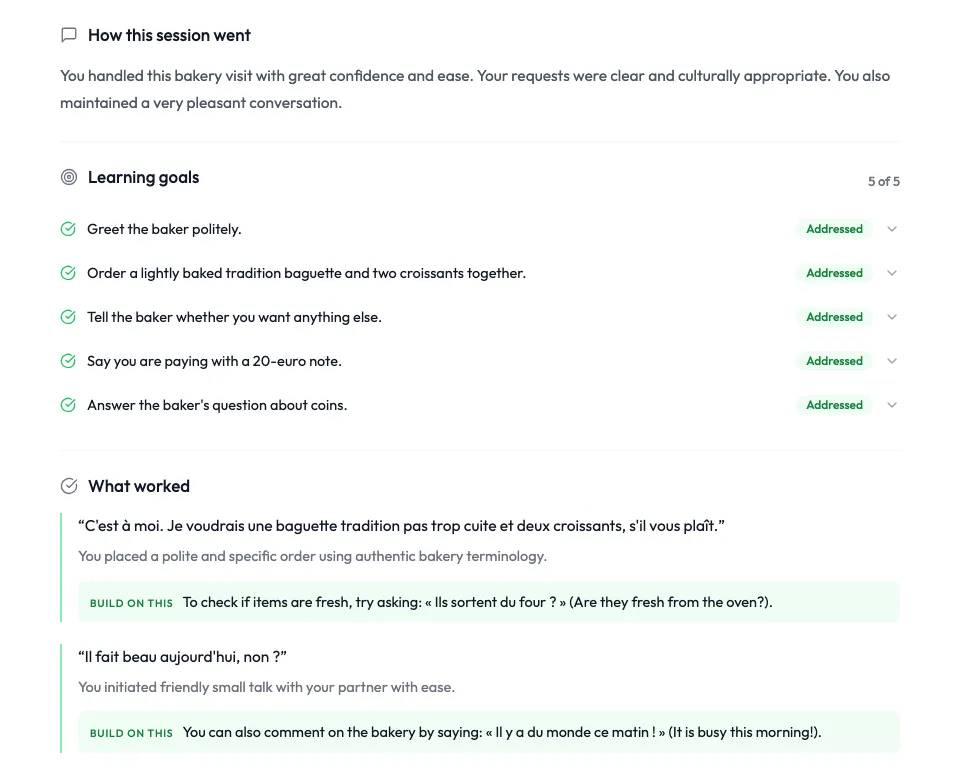
C'est à moi, je voudrais une baguette tradition pas trop cuite et deux croissants, s'il vous plaît.
A clearer way to say it
Ils sortent du four ?
You placed a polite, specific order using real bakery words. To build on it, you can also ask whether the items are fresh from the oven.
What the learner said
Il fait beau aujourd'hui, non ?
A clearer way to say it
Il y a du monde ce matin !
You started friendly small talk with the baker with ease. You can also make a comment about the bakery itself, such as saying it's busy this morning.
Paying, and getting unstuck
Most bakeries take cards and contactless payment. Some small ones post a minimum amount for cards near the register, so keep a few coins for a single baguette.
C'est tout pour moi, merci.
Meaning: That's all for me, thanks.
Your answer to Et avec ceci ? when you're done. Ce sera tout, merci works too.
Je peux payer par carte ?
Meaning: Can I pay by card?
Ask before they ring you up if the total is tiny. Otherwise just hold your card or phone near the reader when they turn it toward you.
Non, désolé, je n'ai pas de monnaie.
Meaning: No, sorry, I don't have any change.
Your answer to Vous avez la monnaie ?. Women write désolée; it sounds the same. If you do have coins, say Attendez, je regarde (hang on, let me look).
Pardon, vous pouvez répéter, s'il vous plaît ?
Meaning: Sorry, could you repeat that, please?
Your repair phrase. Staff say the total and the questions fast, and asking once is completely normal.
Things locals do without thinking
Order in one breath when there's a line
Decide while you wait, then give the bread, how well baked, and the pastries in one sentence, with your card or coins already out. Nobody minds a learner, but long pauses at a busy counter are what people notice. Weekend mornings and the lunch rush are the busiest times.
Pain au chocolat or chocolatine?
Same pastry, two names. In Paris and most of France it's un pain au chocolat. In the southwest, around Toulouse and Bordeaux, people say une chocolatine, and so do French speakers in Quebec. Either one gets you the pastry anywhere; the friendly rivalry over the name is a running joke in France.
The baguette goes home unwrapped
Your baguette usually comes with just a small square of paper around the middle, and people carry it under the arm or in a tote. Eating the end on the walk home is a common habit, and that crusty tip has its own name, le quignon.
Check the closing day
Most independent bakeries close one day a week, and some close for a few weeks in summer. The day is posted on the door, often as Fermé le mercredi (closed Wednesdays) or similar. At lunchtime many also sell sandwiches and a set lunch deal with a drink and dessert.
Practice the order until it's quick
The bakery is a good first real conversation because it's short and predictable. Practice until the greeting, the order, and your answer to the follow-up questions come out without a pause.
- Open Create with AI and paste the description below. Change the bread, the pastries, or the city if you like.
- Talk out loud with the baker: greet first, order everything in one go, answer the follow-up questions, and pay.
- Read your feedback to see which goals you covered and a line you said with a clearer way to say it. Ask the AI Coach about anything in the transcript you're unsure of.
- Run it again and try to finish faster, the way you would with a line behind you.
Describe it like this when you create the activity
Practice French at a busy neighborhood bakery in Paris on a Saturday morning. The AI plays the baker, who asks whose turn it is, whether I want anything else, whether that's all, and whether I have coins when I pay. I should greet the baker first, order a tradition baguette not too well baked and two croissants in one go, then pay with a 20-euro note. Level: beginner (A2).
Questions learners usually ask first
Do you have to say bonjour in a French bakery?
Yes. Greeting the person serving you before you order is expected in French shops, and skipping it comes across as rude even if the rest of your order is polite. Say hello when it's your turn, then order, and finish with a thank-you and a good-day.
What does une tradition mean at a French bakery?
It's short for the traditional French baguette, a category set by a 1993 French decree. It is made from wheat flour, water, salt, and yeast or sourdough, with no additives, and the dough can never be frozen at any stage. It usually costs slightly more than a regular baguette.
Is it pain au chocolat or chocolatine?
Both are the same pastry. The first name is used in Paris and most of France, the second in the southwest and in Quebec. Bakers everywhere will understand either one.
Can you pay by card at a French bakery?
Usually, yes, including contactless with a card or phone. Some small bakeries post a minimum amount for card payments, so a few coins are handy for a single baguette. If you pay with a large note, expect to be asked whether you have smaller change.